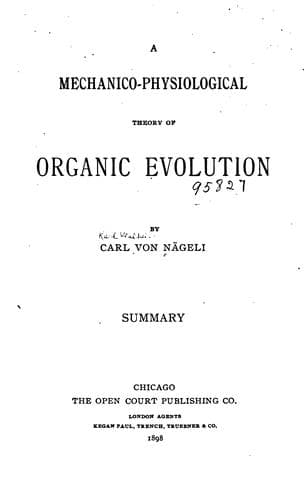
A Mechanico-Physiological Theory of Organic EvolutionNägeli, Carl
Science
A Mechanico-Physiological Theory of Organic Evolution
Nägeli, Carl
Evolution
The larger part of the unarranged, soft and homogenous primordial
plasma, which grows by intussusception, becomes watery soma-plasm, with
unarranged and easily movable micellae. The smaller part is converted in
the course of phylogeny into idioplasm, in which at certain favorable
points the micellae that are being stored up under the influence of
molecular forces arrange themselves into groups by similar orientations,
and hence form bodies of less water content and greater solidity. Each
body of idioplasm consists originally of only one group of micellae,
which, however, necessarily breaks up with increasing additions into
several groups. On account of the dynamic influence of the groups of
micellae upon their own growth, they become in part more distinct and
more definitely separated, in part again differentiated by new irregular
intussusception. This phylogenetic process is continued indefinitely,
by which the combination of forces produces a new configuration, and
conversely, by which a new configuration produces a new combination of
forces, so that the body of idioplasm merely takes on a continually
increasing complexity of configuration by the action of the internal
forces--that is, by the molecular forces of the micellae of the albumen
under the influence of which growth proceeds. This constitutes the
_automatic perfecting process_ or progression of the idioplasm, and
entropy of organic matter. (See p. 47.)
The above described phylogenetic perfecting process of the idoplasm,
which operates through internal causes, is scarcely affected by
differences of nutrition and by climatic conditions influencing
nutrition. On the other hand all those external forces which act as
stimuli during a long period of time in an unvarying manner have a very
noticeable influence on the intussusception of micellae in the idioplasm
and on the molecular processes going on among the micellae. The action of
stimuli determines the particular structure of the groups of micellae
added under the direction of the perfecting process. Thus the
configuration of the idioplasm becomes continually more and more complex
and at the same time assumes a local adaptation corresponding to
external conditions. This constitutes adaptation of the idioplasm.
6. FUNCTION OF THE IDIOPLASM IN GENERAL.
Public-domain text, read in full here on John Shaqi.
Reviews
Reviews
No reviews yet
Be the first to share your thoughts on this work.
Join the Discussion
Join the discussion
Sign in to leave a comment or review.
Sign InorCreate an account