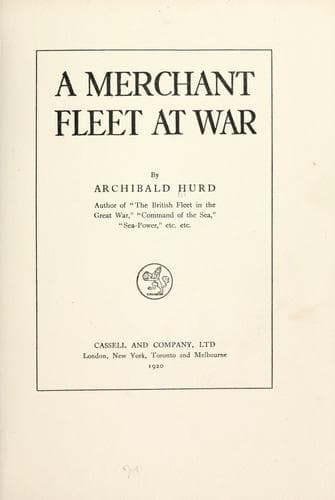
Cunard Steamship Company, ltd.; World War, 1914-1918 -- Naval operations
Such was the beginning of the Cunard Company in the shape of four
wooden paddle-wheel steam vessels, built on the Clyde, the _Britannia_,
_Acadia_, _Caledonia_, and _Columbia_; and its history from then
until 1914 was one of steady and enterprising, cautious and daring,
development. This is not the place to linger in detail over the
technical strides made since 1840 by the Cunard Company’s directors,
but one or two of the more important milestones should perhaps be
noted. In the year 1804, John Stevens in America had successfully
experimented with the screw-propeller, and in 1820, at the Horsley
Iron Works, at Tipton in Staffordshire, Mr. Aaron Manby had designed
and built the first iron steamer. It had always been the policy of the
Cunard Company to keep in touch with every new marine experiment, but
at the same time it had been their wise habit, both from the commercial
point of view and that of the safety of their passengers and crews,
to move circumspectly in the adoption of new devices. It was not,
therefore, until 1852 that the first four iron screw steamships were
added to their fleet, namely the _Australian_, _Sydney_, _Andes_,
and _Alps_, four vessels that were also the first belonging to the
Company to be fitted with accommodation for emigrants. For the next
ten years, however, it was found that passengers still preferred
the old paddle-wheel system, and side by side with their iron screw
steamers, the Company continued to build these until, in 1862, the
_Scotia_ proved to be the last of a dying type. Meanwhile, in 1854,
the Government was to realise another side of the value to the nation
of the Cunard Company. During the Crimean War, in response to a strong
Government appeal, the Company immediately placed at the Admiralty’s
disposal, six of their best steamers, the _Cambria_, _Niagara_,
_Europa_, _Arabia_, _Andes_, and _Alps_; later adding to these their
two most recent acquisitions, the _Jura_ and _Etna_. Throughout the
campaign these eight vessels were continuously employed upon various
important missions, supplying the needs of the military forces.
[Illustration: EMBARKATION: “ARE WE DOWNHEARTED?”]
[Illustration: TRANSPORT IN SOUTHAMPTON WATER: COLONIALS’ FIRST VIEW OF
“BLIGHTY”]
Public-domain text, read in full here on John Shaqi.
Reviews
Reviews
No reviews yet
Be the first to share your thoughts on this work.
Join the Discussion
Join the discussion
Sign in to leave a comment or review.
Sign InorCreate an account