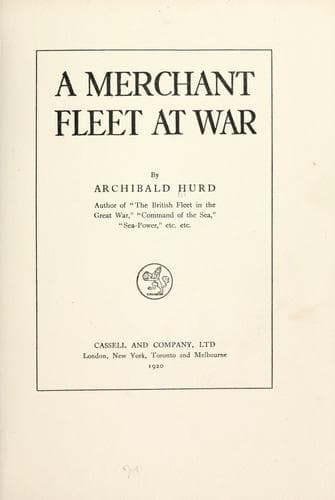
Cunard Steamship Company, ltd.; World War, 1914-1918 -- Naval operations
_Sleep on, O Drake, sleep well,
In days not wholly dire!
Grenville, whom nought could quell,
Unquenched is still thy fire.
And thou that hadst no peer,
Nelson, thou needst not fear!
Thy sons and heirs are here,
And shall not shame their sire._
WILLIAM WATSON.
With the war now over, and after five years, during which the public
mind has been accustomed to emergency arrangements of all sorts,
nothing is more difficult than to reconstruct the enormous and
unprecedented activities that were called so suddenly into being in
the first war weeks of 1914; and in these the Cunard Company had a
typical and vitally important part to play. Of the number of navigating
officers in their employment, namely 163, no fewer than 139 were in
the Royal Naval Reserve, and as such were immediately mobilised, being
instructed to report themselves for naval duty upon their arrival
in a British port; and by the end of the year 131 of these officers
had actually done so. Nor was this the least of the problems that the
Company had to face, in that, at a time when not only every reliable
officer and man was worth his weight in gold to them, so large a
proportion of their best and most highly trained servants had thus to
be yielded up to the senior service.
[Illustration: “MAURETANIA” ESCORTED BY DESTROYERS]
In the latest agreement arrived at with the Government in 1903, the
whole of the Cunard Fleet was, in time of war, to be placed at its
disposal, and there was considerable uncertainty at first as to the
various purposes to which the ships might be allocated. In the present
chapter we shall confine ourselves to dealing with those of the Cunard
vessels that were commandeered by the Admiralty for strictly combatant
purposes, of which the more important were the _Aquitania_, _Caronia_,
_Laconia_, _Campania_, and _Carmania_; and since the _Campania_ had
only just passed from Cunard control, it may be well, perhaps, in view
of her distinguished and lengthy service under the Company’s flag to
deal with her first. She became a seaplane carrier; after having at
first however, taken a large share in repatriating Americans stranded
in the British Isles owing to the exigencies of war. Her after funnel
was removed and a smaller one put abreast of the forward funnel; and
this alteration, together with the dazzle paint with which she was at
a later date covered, rendered her almost unrecognisable even to the
old Cunarders who had been familiar with her for many years. Throughout
the war she was fortunate in escaping injury both from enemy gunfire
and submarine attack, and her honourable career only came to an end
at the conclusion of the armistice, when she was accidentally sunk in
collision with H.M.S. _Revenge_ in the Firth of Forth.
Public-domain text, read in full here on John Shaqi.
Reviews
Reviews
No reviews yet
Be the first to share your thoughts on this work.
Join the Discussion
Join the discussion
Sign in to leave a comment or review.
Sign InorCreate an account