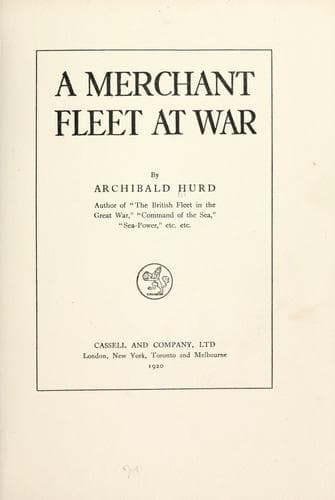
Cunard Steamship Company, ltd.; World War, 1914-1918 -- Naval operations
Now at the beginning of the war it had been a very difficult question
for the directors of the Cunard Company to decide as to whether the
transatlantic traffic, under the new and unprecedented conditions,
would be sufficient to justify the continued running of two such large
and costly vessels as the _Lusitania_ and the _Mauretania_. It was
decided, however, after much consideration, that the _Lusitania_
could be run once a month, providing that her boiler power was reduced
by one-fourth. The consequent saving in coal and labour of this would,
the Directors considered, enable them to run the vessel without loss,
although with no hopes of making a profit. Six of the _Lusitania’s_
boilers were accordingly closed, and the ship began to run in these
conditions in November, 1914, the effect of the closing of the six
boilers being to reduce her maximum speed to 21 knots. It is to be
noted, however, that this reduction still left the _Lusitania_ very
considerably faster than any other transatlantic steamer.
Nor had she lacked in exciting experiences before the fatal 1st of
May, 1915, on which she left New York for the last time. On the very
day that war was declared in 1914, she had started from New York
for Liverpool, under the command of Captain Daniel Dow, one of the
best-known and most respected figures in the Cunard Company’s service,
who retired after 43 years’ service in 1919. Within a few hours of
leaving New York, an enemy warship was sighted on the horizon, and
observed to change her course immediately, with the presumed object of
intercepting the _Lusitania_. Without a moment’s hesitation, Captain
Dow set his course for a fog bank to the south, where he was soon lost
to sight by the enemy. As soon as he was out of view, Captain Dow swung
the _Lusitania_ round again and steamed northwards at his highest
speed. Having thus out-manoeuvred the hostile commander, he resumed
his eastward course again, navigating his great ship by night without
lights, and safely reaching Liverpool.
Again in February, 1915, while Captain Dow was still in command of her,
the _Lusitania_, on an eastward voyage, received a wireless message to
the effect that enemy submarines were cruising in the Irish Sea. He
received instructions to fly a neutral flag--a perfectly legitimate
ruse--and having on board some 400 Americans, together with the United
States mails, he decided to hoist the American flag. Having done so,
he crossed the Irish Sea at full speed, without stopping to take up
a pilot; steered straight for the Mersey, and once more brought his
vessel home in safety. Soon after this, Captain Dow, upon whom the
strain of responsibility had been very great, was retained ashore by
the Directors for a brief and much needed rest, and Captain W. T.
Turner, one of the Cunard Company’s most trusted commanders took his
place, with an assistant captain, Captain Anderson, also on board.
Public-domain text, read in full here on John Shaqi.
Reviews
Reviews
No reviews yet
Be the first to share your thoughts on this work.
Join the Discussion
Join the discussion
Sign in to leave a comment or review.
Sign InorCreate an account