This in fine is the most summary statement of his career in
literature,--that he has been a keen and sympathetic observer of life, and
has caught its character, not like a reporter going about with a kodak and
snapping it aimlessly at any conspicuous object, but like an alert artist
who goes back to his studio after a walk and sets down his comments on what
he has seen in quick, accurate sketches, now and then resolving numberless
undrawn sketches into some one comprehensive and beautiful picture.
THE SEQUENCE OF MR. HOWELLS'S BOOKS.
Mr. Howells is the author of nearly seventy books, from which the following
are selected as best representing his work in various fields and at various
periods.
Venetian Life. Travel and description. 1867.
Their Wedding Journey. Novel. 1871.
Italian Journeys. Travel and description. 1872.
Suburban Sketches. 1872.
Poems. 1873 and 1895.
A Chance Acquaintance. Novel. 1873.
A Foregone Conclusion. Novel. 1874.
A Counterfeit Presentment. Comedy. 1877.
The Lady of the Aroostook. Novel. 1879.
The Undiscovered Country. Novel. 1880.
A Fearful Responsibility, and Other Stories. 1881.
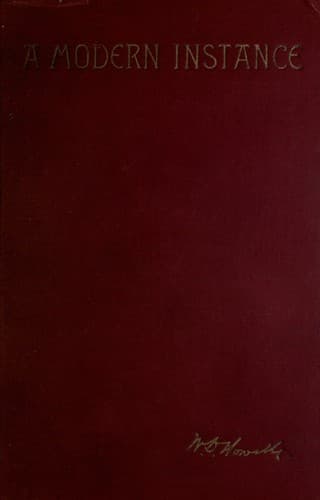
A Modern Instance. Novel. 1881.
The Rise of Silas Lapham. Novel. 1884.
Tuscan Cities. Travel and description. 1885.
April Hopes. Novel. 1887.
A Hazard of New Fortunes. Novel. 1889.
The Sleeping Car, and Other Farces. 1889.
A Boy's Town. Reminiscences. 1890.
Criticism and Fiction. Essays. 1891.
My Literary Passions. Essays. 1895.
Stops of Various Quills. Poems. 1895.
Literary Friends and Acquaintances. Reminiscences, 1900.
Heroines of Fiction. Criticism. 1901.
The Kentons. Novel. 1902.
Literature and Life. Criticism. 1902.
London Films. Travel and Description. 1905.
A MODERN INSTANCE.
I.
The village stood on a wide plain, and around it rose the mountains. They
were green to their tops in summer, and in winter white through their
serried pines and drifting mists, but at every season serious and
beautiful, furrowed with hollow shadows, and taking the light on masses
and stretches of iron-gray crag. The river swam through the plain in long
curves, and slipped away at last through an unseen pass to the southward,
tracing a score of miles in its course over a space that measured but three
or four. The plain was very fertile, and its features, if few and of purely
utilitarian beauty, had a rich luxuriance, and there was a tropical riot of
vegetation when the sun of July beat on those northern fields. They waved
with corn and oats to the feet of the mountains, and the potatoes covered
a vast acreage with the lines of their intense, coarse green; the meadows
were deep with English grass to the banks of the river, that, doubling and
returning upon itself, still marked its way with a dense fringe of alders
and white birches.
Public-domain text, read in full here on John Shaqi.
Reviews
Reviews
No reviews yet
Be the first to share your thoughts on this work.
Join the Discussion
Join the discussion
Sign in to leave a comment or review.
Sign InorCreate an account