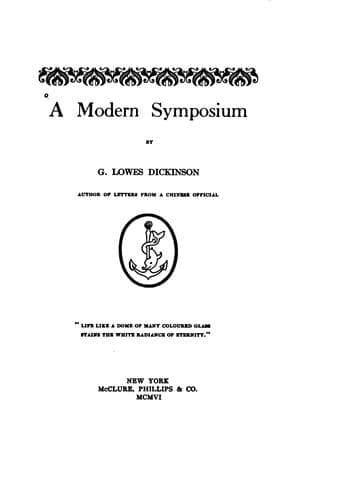
A modern symposiumDickinson, G. Lowes (Goldsworthy Lowes)
Philosophy
A modern symposium
Dickinson, G. Lowes (Goldsworthy Lowes)
Great Britain -- Social conditions; Social problems
"Let me say then first, that in listening to the speakers who have
preceded me, while admiring the beauty and ingenuity of the
superstructures they have raised, I have been busy, according to my
practice, in questioning the foundations. And this is the kind of
result I have arrived at. All political convictions vary between the
two extremes which I will call Collectivism and Anarchy. Each of these
pursues at all costs a certain end--Collectivism, order, and Anarchy,
liberty. Each is held as a faith and propagated as a religion. And
between them lie those various compromises between faith and
experience, idea and fact, which are represented by liberalism,
conservatism, and the like. Now, the degree of enthusiasm which
accompanies a belief, is commonly in direct proportion to its freedom
from empirical elements. Simplicity and immediacy are the
characteristics of all passionate conviction. But a critic like myself
cannot believe that in politics, or anywhere in the field of practical
action, any such simple and immediate beliefs are really and wholly
true. Thus, in the case before us, I would point out that neither
liberty nor order are sufficient ends in themselves, though each, I
think, is part of the end. The liberty that is desirable is that of
good people pursuing Good in order; and the order that is desirable is
that of good people pursuing Good in liberty. This is a correction
which, perhaps, both collectivist and anarchist would accept. What
they want, they would say, is that kind of liberty and that kind of
order which I have described. But as liberty and order, so conceived,
imply one another, the difference between the two positions ceases to
be one of ends and becomes one of means. But every problem of means is
one of extreme complexity which can only be solved, in the most
tentative way, by observation and experiment. And opinions based upon
such a process, though they may be strongly held, cannot be held with
the simplicity and force of a religious or ethical intuition. We
might, conceivably, on this basis adopt the position either of the
collectivist or of the anarchist; but we should do so not as
enthusiasts, but as critics, with a full consciousness that we are
resting not upon an absolute principle, but upon a balance of
probabilities.
Public-domain text, read in full here on John Shaqi.
Reviews
Reviews
No reviews yet
Be the first to share your thoughts on this work.
Join the Discussion
Join the discussion
Sign in to leave a comment or review.
Sign InorCreate an account