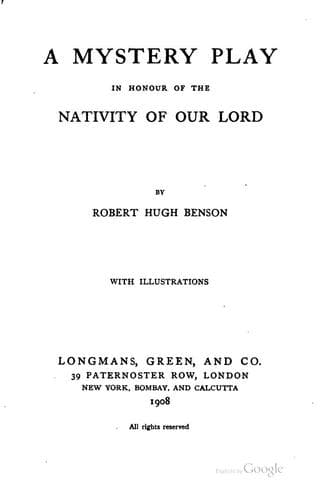
A Mystery Play in Honour of the Nativity of our Lord — John Shaqi
A Mystery Play in Honour of the Nativity of our LordBenson, Robert Hugh
Religion
A Mystery Play in Honour of the Nativity of our Lord
Benson, Robert Hugh
Christmas plays
[_Music of “Adeste Fideles” instantly begins, ff.; the
curtain comes down; then rises again to show_ MARY
_coped and crowned; then after one chord all begin
to sing—all on their knees. At end of first verse_
GASPAR _rises, then_ MELCHIOR, BALTHASAR, ZACHARY,
TWO SHEPHERDS, ABEL, MARTHA, DAVID, SERVANTS,
ANGELS—_each one by one comes up, genuflects at
dais, and kisses the_ CHILD’S _foot and_ MARY’S
_hand. Meantime_ JOSEPH, _kneeling at side, censes
them. At end of last chorus, as last line begins_,
MARY _stands, and as she makes Sign of Cross with_
CHILD, _all cross themselves_.
CURTAIN.
[Illustration]
APPENDICES
I. THE SCENERY
The stage on which the play was acted was about four feet in height,
twenty-four in width, and twenty-four in depth. It was furnished
temporarily with footlights consisting of gas-tubing pierced by seven
burners shaded with tin head-lights permanently fixed, two side-lights
also permanent, and two incandescent burners behind the back-scene.
As substitutes for all these except the last, oil lamps are suggested,
hung or standing and guarded with wire; for the last, a strong
acetylene light.
The scenery throughout consisted of these things only—a permanent back
scene, hung from a roller, constructed of opaque, dark, grey-blue paper
pierced irregularly with very small holes; six wings, three on a side;
two dark curtains hung on a wire to slide backwards or forwards across
the back-scene, about a dozen dust-sheets and a quantity of brown paper
and cotton-wool. (It must be remembered that the object was not to
produce startling stage effects, but rather a soothing and suggestive
background.)
These extremely simple accessories were employed as follows:
_First Scene._—The curtains were drawn back out of sight altogether
behind the backmost wings. The floor was entirely and irregularly
covered with dust-sheets, and, to aid the appearance of irregularity,
various objects, such as footstools and blocks of wood were placed
beneath them. The wings were managed in this manner. Each of them was
a light framework of about three feet in width and ten in height.
One side of them (that presented to the audience in this scene) was
covered with large sheets of brown paper of all shades, deliberately
crumpled and bulging, and, here and there stained with paint. Upon the
upper side of each irregularity was gummed a flat thick piece of wide
wadding, following the curve of the paper, to represent fallen snow.
These six wings, placed of course not parallel with the back-scene but
slightly towards it, provided three exits on each side, two of which
only were used.
Public-domain text, read in full here on John Shaqi.
Reviews
Reviews
No reviews yet
Be the first to share your thoughts on this work.
Join the Discussion
Join the discussion
Sign in to leave a comment or review.
Sign InorCreate an account