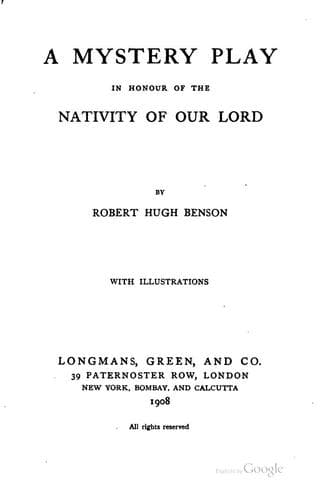
A Mystery Play in Honour of the Nativity of our LordBenson, Robert Hugh
Religion
A Mystery Play in Honour of the Nativity of our Lord
Benson, Robert Hugh
Christmas plays
It must be remembered that the play does not attempt realism. It is
full of deliberate anachronisms. To act, then, in a realistic manner
would be to appeal to the eye in one key and to the dramatic perception
in another. It was found therefore necessary during the rehearsals
to insist again and again upon a certain conventionality in gestures
and tones of voices. The actors were encouraged to be slow, to speak
extremely clearly, and to make large deliberate gestures rather than
spontaneous movements—to beckon, for instance, with the arm rather
than the hand. (This method was, of course, that followed in the recent
performances of “Everyman.”) On these lines it was found that the play
occupied slightly over two hours.
Especially necessary was this system in the case of such characters
as those of the “Herald,” “Mary,” “Joseph,” and the “Three Kings.”
The “Herald,” standing outside the curtains, holds himself perfectly
upright for the most part. When he bows, he bows low with both hands
across the breast; when he signs himself with the cross, he slowly
“envelops” himself [as M. Huysmans says] in his movement. The appeal of
“Mary” also depends entirely (since she does not speak) upon extremely
slow, dignified movements. When she swoons she remains motionless, sunk
upon herself; when she moves, she does so with extreme deliberation;
she looks for a long time at the character to whom she directs herself,
before moving in his regard.
In the same manner, “Joseph” is lost always in a contemplation of
“Mary”; his eyes are fixed on her; he keeps the same attitude for long
together.
So, too, with the “Three Kings.” They carry themselves extremely
upright, they make sweeping gestures, they chant rather than speak,
they bow and genuflect slowly and profoundly. The “Children” only are
allowed to be spontaneous, without being abrupt.
The character of “Zachary” is the most difficult of performance.
He has to avoid prosiness on one side and passion on the other;
“deliberateness” must be his watch-word. I am afraid he is rather a
tiresome person; but he is as necessary as the Greek chorus, to whom he
corresponds. He appears less tiresome if he is represented by a very
tall actor who carries himself bent.
Those responsible, then, for rehearsals, must not be afraid of long
silences in which little happens. The play is intended as a series of
meditations rather than of dramatic situations and developments. Again
and again, if the grouping is arranged upon a wide and semi-heroic
scale, the actors will be found to fall into tableaux, which may
well be looked at in silence. During the longer of these involuntary
tableaux, however, music is sung or played.
Printed by BALLANTYNE, HANSON & CO.
Edinburgh & London
FOOTNOTES:
[1] Bramley and Stainer’s “Christmas Carols, New and Old,” 1st Series,
No. 1.
[2] B. & S., 1st Series, No. 19.
[3] B. & S., 2nd Series, No. 21.
[4] B. & S., 1st Series, No. 3.
Public-domain text, read in full here on John Shaqi.
Reviews
Reviews
No reviews yet
Be the first to share your thoughts on this work.
Join the Discussion
Join the discussion
Sign in to leave a comment or review.
Sign InorCreate an account