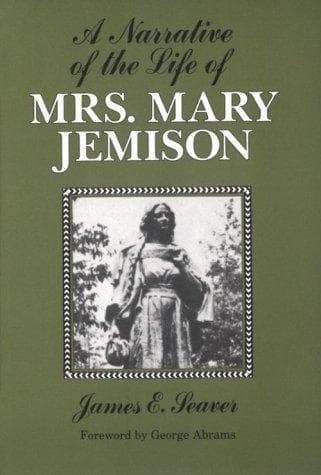
A Narrative of the Life of Mrs. Mary JemisonSeaver, James E. (James Everett)
History
A Narrative of the Life of Mrs. Mary Jemison
Seaver, James E. (James Everett)
Jemison, Mary, 1743-1833; Seneca Indians
In the last war, (1814,) an Indian who had been on fatigue, called at
a commissary's and begged some bread. He was sent for a pail of water
before he received it, and while he was absent an officer told the
commissary to put a piece of money into the bread, and observe the
event. He did so. The Indian took the bread and went off: but on the
next day having ate his bread and found the money, he came to the
commissary and gave him the same, as the officer had anticipated.
Little Beard, a celebrated Indian Chief, having arrived to a very
advanced age, died at his town on the Genesee river about the first of
June, 1806, and was buried after the manner of burying chiefs. In his
life time he had been quite arbitrary, and had made some enemies whom he
hated, probably, and was not loved by them. The grave, however, deprives
envy of its malignity, and revenge of its keenness.
Little Beard had been dead but a few days when the great eclipse of the
sun took place, on the sixteenth of June, which excited in the Indians
a great degree of astonishment; for as they were ignorant of astronomy,
they were totally unqualified to account for so extraordinary a
phenomenon. The crisis was alarming, and something effectual must be
done, without delay, to remove, if possible, the cause of such coldness
and darkness, which it was expected would increase. They accordingly ran
together in the three towns near the Genesee river, and after a short
consultation agreed that Little Beard, on the account of some old grudge
which he yet cherished towards them, had placed himself between them and
the sun, in order that their corn might not grow, and so reduce them to
a state of starvation. Having thus found the cause, the next thing was
to remove it, which could only be done the use of powder and ball.
Upon this, every gun and rifle was loaded, and a firing commenced, that
continued without cessation till the old fellow left his seat, and the
obscurity was entirely removed, to the great joy of the ingenious and
fortunate Indians.
In the month of February, 1824, Corn Planter, a learned pagan Chief
at Tonnewonta, died of common sickness. He had received a liberal
education, and was held in high estimation in his town and tribe, by
both parties; but the pagans more particularly mourned his loss deeply,
and seemed entirely unreconciled. They imputed his death to witchcraft,
and charged an Indian by the name of Prompit, with the crime.
Mr. Prompit is a Christian Indian, of the Tuscarora nation, who has
lived at Tonnewonta a number of years, where he has built a saw-mill
himself, which he owns, and is considered a decent, respectable man.
Public-domain text, read in full here on John Shaqi.
Reviews
Reviews
No reviews yet
Be the first to share your thoughts on this work.
Elsewhere in the archive
Join the Discussion
Join the discussion
Sign in to leave a comment or review.
Sign InorCreate an account