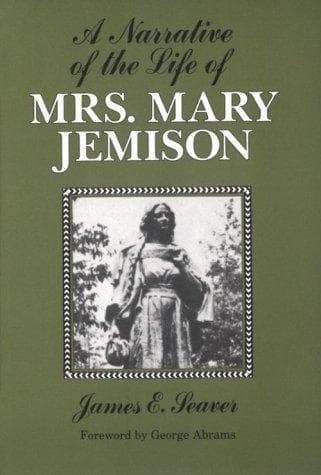
A Narrative of the Life of Mrs. Mary JemisonSeaver, James E. (James Everett)
History
A Narrative of the Life of Mrs. Mary Jemison
Seaver, James E. (James Everett)
Jemison, Mary, 1743-1833; Seneca Indians
About two weeks after the death of Corn Planter, Mr. Prompit happened in
company where the author was present, and immediately begun to converse
upon that subject. He said that the old fashioned Indians called him a
witch--believed that he had killed Corn Planter, and had said that
they would kill him. But, said he, all good people know that I am not a
witch, and that I am clear of the charge. Likely enough they will kill
me; but if they do, my hands are clean, my conscience is clear, and I
shall go up to God. I will not run nor hide from them, and they may kill
me if they choose to--I am innocent. When Jesus Christ's enemies, said
he, wanted to kill him, he did not run away from them, but let them kill
him; and why should I run away from my enemies?
How the affair will terminate, we are unable to decide.
* * * * *
DESCRIPTION OF GENESEE RIVER AND ITS BANKS, FROM MOUNT MORRIS TO THE
UPPER FALLS.
From Mount Morris the banks of the Genesee are from two to four hundred
feet in height, with narrow flats on one side of the river or the other,
till you arrive at the tract called Gardow, or Cross Hills. Here you
come to Mrs. Jemison's flats, which are two miles and a quarter long,
and from eighty to one hundred and twenty rods wide, lying mostly on the
west side of the river.
Near the upper end of these flats is the Great Slide. Directly above
this, the banks (still retaining their before mentioned height) approach
so near each other as to admit of but thirty acres of flat on one side
of the river only, and above this the perpendicular rock comes down to
the water.
From Gardow you ascend the river five miles to the lower falls, which
are ninety-three feet perpendicular. These falls are twenty rods wide,
and have the greatest channel on the east side. From Wolf creek to these
falls the banks are covered with elegant white and Norway pine.
Above the lower falls the banks for about two miles are of perpendicular
rock, and retain their height of between two and four hundred feet.
Having travelled this distance you reach the middle falls, which are an
uninterrupted sheet of water fifteen rods wide, and one hundred and ten
feet in perpendicular height. This natural curiosity is not exceeded
by any thing of the kind in the western country, except the cataract at
Niagara.
From the middle falls the banks gradually rise, till you ascend the
river half a mile, when you come to the upper falls, which are somewhat
rolling, 66 feet, in the shape of a harrow. Above this the banks are
of moderate height. The timber from the lower to the upper falls is
principally pine. Just above the middle falls a saw-mill was erected
this season (1823) by Messrs. Ziba Hurd and Alva Palmer.
HUNTING ANECDOTE.
Public-domain text, read in full here on John Shaqi.
Reviews
Reviews
No reviews yet
Be the first to share your thoughts on this work.
Elsewhere in the archive
Join the Discussion
Join the discussion
Sign in to leave a comment or review.
Sign InorCreate an account