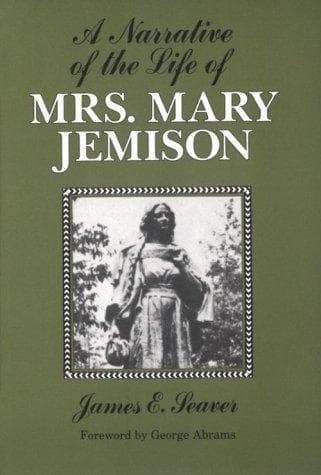
A Narrative of the Life of Mrs. Mary JemisonSeaver, James E. (James Everett)
History
A Narrative of the Life of Mrs. Mary Jemison
Seaver, James E. (James Everett)
Jemison, Mary, 1743-1833; Seneca Indians
On these occasions the Chiefs describe a perfectly straight line, half
an inch wide, and perhaps ten miles long, which they direct their people
to travel upon by placing one foot before the other, with the heel of
one foot to the toe of the other, and so on till they arrive at the end.
The meaning of which is, that they must not turn aside to the right hand
or to the left into the paths of vice, but keep straight ahead in the
way of well doing, that will lead them to the paradise of Nauwaneu.
The second feast is after planting; when they render thanks for
the pleasantness of the season--for the good time they have had for
preparing their ground and planting their corn; and are instructed by
their Chiefs, by what means to merit a good harvest.
When the green corn becomes fit for use, they hold their third, or green
corn feast. Their fourth is celebrated after corn harvest; and the fifth
at the close of their year, and is always celebrated at the time of the
old moon in the last of January or first of February. This last deserves
a particular description.
The Indians having returned, from hunting, and having brought in all the
venison and skins that they have taken, a committee is appointed,
says Mrs. Jemison, consisting of from ten to twenty active men, to
superintend the festivities of the great sacrifice and thanksgiving that
is to be immediately celebrated. This being done, preparations are
made at the council-house, or place of meeting, for the reception and
accommodation of the whole tribe; and then the ceremonies are commenced,
and the whole is conducted with a great degree of order and harmony,
under the direction of the committee.
Two white dogs, [Footnote: This was the practice in former times; but at
present I am informed that only one dog is sacrificed.] without spot or
blemish, are selected (if such can be found, and if not, two that have
the fewest spots) from those belonging to the tribe, and killed near the
door of the council-house, by being strangled. A wound on the animal or
an effusion of blood, would spoil the victim, and render the sacrifice
useless. The dogs are then painted red on their faces, edges of their
ears, and on various parts of their bodies, and are curiously decorated
with ribbons of different colors, and fine feathers, which are tied and
fastened on in such a manner as to make the most elegant appearance.
They are then hung on a post near the door of the council-house, at the
height of twenty feet from the ground.
Public-domain text, read in full here on John Shaqi.
Reviews
Reviews
No reviews yet
Be the first to share your thoughts on this work.
Elsewhere in the archive
Join the Discussion
Join the discussion
Sign in to leave a comment or review.
Sign InorCreate an account