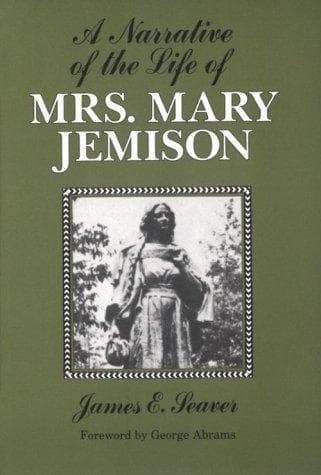
A Narrative of the Life of Mrs. Mary JemisonSeaver, James E. (James Everett)
History
A Narrative of the Life of Mrs. Mary Jemison
Seaver, James E. (James Everett)
Jemison, Mary, 1743-1833; Seneca Indians
This feast continues nine days, [Footnote: At present, as I have been
informed, this feast is not commonly held more than from five to seven
days. In former times, and till within a few years, nine days were
particularly observed.] and during that time the Chiefs review the
national affairs of the year past; agree upon the best plan to be
pursued through the next year, and attend to all internal regulations.
On the last day, the whole company partake of an elegant dinner,
consisting of meat, corn and beans, boiled together in large kettles,
and stirred till the whole is completely mixed and soft. This mess is
devoured without much ceremony--some eat with a spoon, by dipping out of
the kettles; others serve themselves in small dippers; some in one way,
and some in another, till the whole is consumed. After this they perform
the war dance, the peace dance, and smoke the pipe of peace; and then,
free from iniquity, each repairs to his place of abode, prepared to
commence the business of a new year. In this feast, temperance is
observed, and commonly, order prevails in a greater degree than would
naturally be expected.
They are fond of the company of spectators who are disposed to be
decent, and treat them politely in their way; but having been frequently
imposed upon by the whites, they treat them generally with indifference.
* * * * *
OF THEIR DANCES.
Of these, two only will be noticed. The war dance is said to have
originated about the time that the Six Nations, or Northern Indians,
commenced the old war with the Cherokees and other Southern Indian
Nations, about one hundred years ago.
When a tribe, or number of tribes of the Six Nations, had assembled for
the purpose of going to battle with their enemies, the Chiefs sung
this song, and accompanied the music with dancing, and gestures that
corresponded with the sentiments expressed, as a kind of stimulant to
increase their courage, and anxiety to march forward to the place of
carnage.
Those days having passed away, the Indians at this day sing the 'war
song,' to commemorate the achievements of their fathers, and as a kind
of amusement. When they perform it, they arm themselves with a war-club,
tomahawk and knife, and commence singing with firm voice, and a stern,
resolute countenance: but before they get through they exhibit in their
features and actions the most shocking appearance of anger, fury and
vengeance, that can be imagined: No exhibition of the kind can be more
terrifying to a stranger.
Public-domain text, read in full here on John Shaqi.
Reviews
Reviews
No reviews yet
Be the first to share your thoughts on this work.
Elsewhere in the archive
Join the Discussion
Join the discussion
Sign in to leave a comment or review.
Sign InorCreate an account