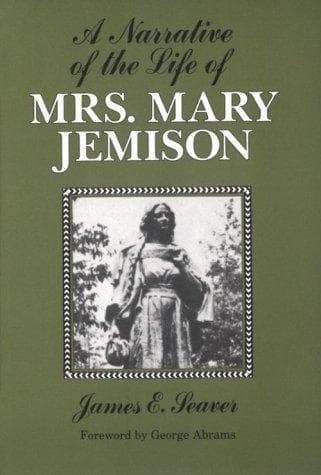
A Narrative of the Life of Mrs. Mary JemisonSeaver, James E. (James Everett)
History
A Narrative of the Life of Mrs. Mary Jemison
Seaver, James E. (James Everett)
Jemison, Mary, 1743-1833; Seneca Indians
The song requires a number of repetitions in the tune, and has a chorus
that is sung at the end of each verse. I have not presumed to arrange it
in metre; but the following is the substance: "We are assembled in the
habiliments of war, and will go in quest of our enemies. We will march
to their land and spoil their possessions. We will take their women and
children, and lead them into captivity. The warriors shall fall by our
war-clubs--we will give them no quarter. Our tomahawks we will dip in
their brains! with our scalping knives we will scalp them." At each
period comes on the chorus, which consists of one monosyllable only,
that is sounded a number of times, and articulated like a faint, stifled
groan. This word is "eh," and signifies "we will," or "we will go," or
"we will do." While singing, they perform the ceremony of killing and
scalping, with a great degree of dexterity.
The peace dance is performed to a tune without words, by both sexes. The
Indians stand erect in one place, and strike the floor with the heel
and toes of one foot, and then of the other, (the heels and toes all the
while nearly level,) without changing their position in the least. The
squaws at the same time perform it by keeping the feet close together,
and without raising them from the ground, move a short distance to the
right, and then to the left, by first moving their toes and then their
heels. This dance is beautiful, and is generally attended with decency.
* * * * *
OF THEIR GOVERNMENT.
Their government is an oligarchy of a mixed nature; and is administered
by Chiefs, a part of whose offices are hereditary, and a part elective.
The nation is divided into tribes, and each tribe commonly has
two Chiefs. One of these inherits his office from his father. He
superintends all civil affairs in the tribe; attends the national
council, of which he is a member; assents to all conveyances of land,
and is consulted on every subject of importance. The other is elected
by the tribe, and can be removed at the pleasure of his constituents
for malconduct. He also is a member of the national council: but his
principal business is to superintend the military concerns of his tribe,
and in war to lead his warriors to battle. He acts in concert with the
other Chief, and their word is implicitly relied on, as the law by which
they must be governed. That which they prohibit, is not meddled with.
The Indian laws are few, and easily expounded. Their business of a
public nature is transacted in council, where every decision is final.
They meet in general council once a year, and sometimes oftener. The
administration of their government is not attended with expense. They
have no national revenue, and consequently have no taxes.
* * * * *
THE EXTENT AND NUMBER OF THE SIX NATIONS.
The Six Nations in the state of New-York are located upon several
reservations, from the Oneida Lake to the Cattaraugus and Allegany
rivers.
Public-domain text, read in full here on John Shaqi.
Reviews
Reviews
No reviews yet
Be the first to share your thoughts on this work.
Elsewhere in the archive
Join the Discussion
Join the discussion
Sign in to leave a comment or review.
Sign InorCreate an account