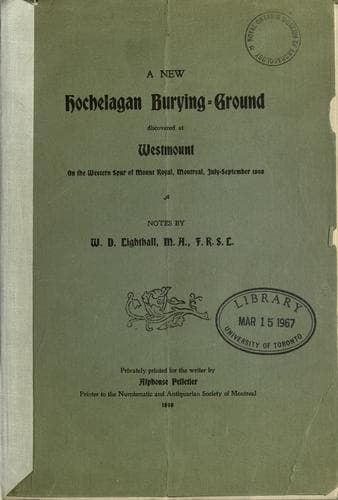
A New Hochelagan Burying-ground Discovered at Westmount on the Western Spur of Mount Royal, Montreal, July-September, 1898Lighthall, W. D. (William Douw)
History
A New Hochelagan Burying-ground Discovered at Westmount on the Western Spur of Mount Royal, Montreal, July-September, 1898
Having just been paying some attention to the
archaeology of the Iroquois, which had been taken me on a flying trip
to their former country in the State of New-York, I, on seeing in a
newspaper at the seaside, a short item concerning the skeletons, was
immediately interested, and especially in the possibility of their
being Hochelagans, and having particularly commenced some inquiries
into the relations between the latter Indians and the Mohawks, I
wrote, as Chairman of Health of Westmount, asking Chief Harrison to
note the manner and attitude of burial and any objects found, and to
enquire concerning previous excavations in the neighborhood and save
the remains for scientific purposes. (They had been sent by him to the
City Morgue.) The above information concerning the previous skeletons
was then collected and I found that the witnesses concurred in
agreeing that the attitude seems to have been in all cases with
knees bent up. No objects seem to have been noticed in any of the
excavations then made, though some may have been overlooked by the
workmen, particularly as the soil of the locality is full of pieces of
limestone and small boulders, closely resembling arrow heads, hammers
and celts. Several bones which are not human have however been since
found with these three skeletons, one possibly of a dog, another of
a squirrel. They may be those of the funeral feast Sir William Dawson
mentions in his work "Fossil Men," as usually to be looked for over
the Hochelagan graves.
Mr. Beauchamp, the New-York authority, writes concerning the Mohawks;
"Burial customs varied greatly among the same people, but usually the
knees are drawn up. The face might be turned either way in contiguous
graves. I have seen many opened with no articles in them." By the
kindness of Dr. Wyatt Johnston, Pathologist to the Provincial Board
of Health, the three skeletons have been preserved and are now in
the Chateau de Ramezay Historical Museum where they will doubtless
be regarded with interest by scholars. The skulls have been fully
identified as of the Indian type, and found to be those of two
powerful males in the prime of life and one young woman. The skull
in possession of Mr. Earl is doubtless of the same race. Some large
stones were found placed above the bodies, and also a number of
naturally flat stones which appear to have been used as scoops to
excavate. The plateau where the remains were found is about half way
up the side of the "Mountain" or hill, as it more properly is, the
total height being only about 700 feet. The plateau slopes somewhat
and looks towards the south-east, and being protected by the hill
behind it from prevailing winds, and having a good light soil,
constitutes a very favorable situation for the growth of the Indian
crops of corn and beans. The Mountain being an isolated rise in the
great plain of the St. Lawrence, the plateau was also most favorably
placed for look-out and defence. A hundred yards or so to the west is
Public-domain text, read in full here on John Shaqi.
Reviews
Reviews
No reviews yet
Be the first to share your thoughts on this work.
Join the Discussion
Join the discussion
Sign in to leave a comment or review.
Sign InorCreate an account