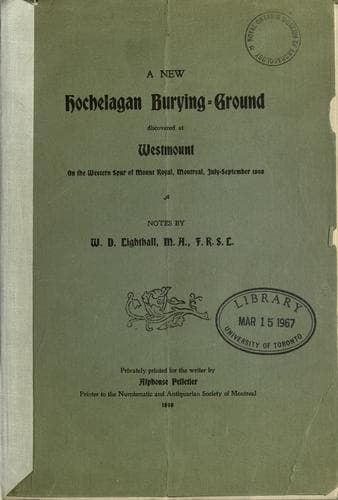
A New Hochelagan Burying-ground Discovered at Westmount on the Western Spur of Mount Royal, Montreal, July-September, 1898Lighthall, W. D. (William Douw)
History
A New Hochelagan Burying-ground Discovered at Westmount on the Western Spur of Mount Royal, Montreal, July-September, 1898
The skull is round and arched above the breadth index being 77.7, of
brachycephalic or Mongoloid type. _The superciliary_ ridges are not
very prominent, but the frontal, parietal and occipital eminences
are very distinct. _The forehead_ is non receding and the breath
measures 9 c.m. The cheekbones are not unduly prominent, the official
measurement being 119 m.m. The gnathic index is 93, or orthognathous.
The teeth are well preserved and not much worn, the 3d. molars not
having erupted in either jaw. The face is short and broad, the height
being 108 m.m. in and breadth 119 m.m., the orbit is inclined to be
square with rounded angles and the type megaseme, the nasal index is
mesorhine.
A very striking feature of this skull is the well marked central
vertical frontal ridge and some tendency to angularity of the vertex.
In the whole this skull is of a more refined type than the others and
suggestive of some fair intellectual development of the individual.
There are two wormian bones on the left side of the skull, one at the
pterion and one below the asterion each being 9 m.m. long.
The bones generally are fragile and the long bones slender, with no
marked impression for muscular attachment. A curious fact is that the
ends of all the long bones are absent, presumably from decay, and as
these ends are united to the shafts between the age of puberty (14-15)
and adult life it is suggestive that the individual may have been
of about the age of 18 or 20 and this is somewhat confirmed by the
noneruption of the third molars.
With this skeleton are two animal bones. White and very dense in
structure. They are both femura, one probably that of an ungulate; the
other of a carnivore.
No. II.--A Brachycephalic Man
This skeleton is that of a large and powerfully built man, the bones
being very heavy and strong with marked impressions and prominences
for muscular attachment. The skeleton, with the exception of some of
the small bones of the hands and feet is complete.
The skull is large and massive, and the lower jaw very strong and
heavy. The teeth are well preserved but much ground down at the crown.
The superciliary ridges are very prominent. The fore head is narrow
(102 c.m.) receding.
Judging from the size and strength of the bones and their impressions
for muscular attachment, this man must have been very powerful and
calculating from the length of the femur, at least six feet tall.
With this skeleton we found a small humerus of some mammal possibly a
squirrel.
No. III.--The Tallest Man
This skeleton is also that of a large powerfully built man, even
taller man the last. The skull is larger, though not quite so massive.
It is longer and narrower and dolicephalus, the occipital region very
prominent. The height index is low (70.5).
The face is broad as compared with the length 124-112 and the cheek
bones are prominent, lower jaw is heavy and strong.
Public-domain text, read in full here on John Shaqi.
Reviews
Reviews
No reviews yet
Be the first to share your thoughts on this work.
Join the Discussion
Join the discussion
Sign in to leave a comment or review.
Sign InorCreate an account