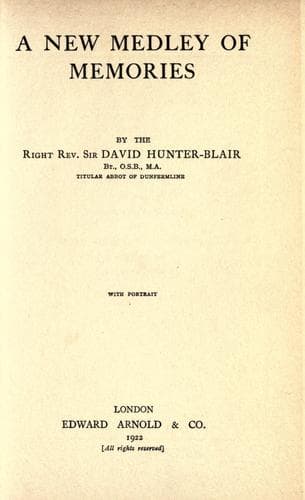
A New Medley of MemoriesHunter Blair, David Oswald, Sir
Religion
A New Medley of Memories
Hunter Blair, David Oswald, Sir
Hunter Blair, David Oswald, Sir, 1853-1939
I take up again the thread of these random recollections in the autumn
of 1903, the same autumn in which I kept my jubilee birthday at St.
Andrews. I went from there successively to the Herries' at Kinharvie,
the Ralph Kerrs at Woodburn, near Edinburgh, and the Butes at
Mountstuart, meeting, curiously enough, at all three places Norfolk and
his sister, Lady Mary Howard--though it was not so curious after all,
as the Duke was accustomed to visit every autumn his Scottish relatives
at these places, as well as the Loudouns in their big rather
out-at-elbows castle in Ayrshire. He had no taste at all either for
shooting, fishing, or riding, or for other country pursuits such as
farming, forestry, or the like; but he made himself perfectly happy
during these country house visits. The least exacting of guests, he
never required to be amused, contenting himself with a game of croquet
(the only outdoor game he favoured), an occasional long walk, and a
daily romp with his young relatives, the children of the house, who
were all devoted to him. He read the newspapers perfunctorily, {2} but
seldom opened a book: he knew and cared little for literature, science,
or art, with the single exception of architecture, in which he was
keenly interested. The most devout of Catholics, he was nothing of an
ecclesiologist: official and hereditary chief of the College of Arms,
he was profoundly uninterested in heraldry, whether practically or
historically:[1] the head of the nobility of England, he was so little
of a genealogist that he was never at pains to correct the
proof--annually submitted to him as to others--of the preposterous
details of his pedigree as set forth in the pages of "Burke." I seem
to be describing an ignoramus; but the interesting thing was that the
Duke, with all his limitations, was really nothing of the kind. He
could, and did, converse on a great variety of subjects in a very
clear-headed and intelligent way; there was something engaging about
his utter unpretentiousness and deference to the opinions of others;
and he had mastered the truth that the secret of successful
conversation is to talk about what interests the other man and not what
interests oneself. No one could, in fact, talk to the Duke much, or
long, without getting to love him; and every one who came into contact
with him in their several degrees, from princes and prelates and
politicians to cabmen and crossing-sweepers, did love him. "His Grace
'as a good 'eart, that's what 'e 'as," said the old lady who used to
keep the crossing nearly opposite Norfolk House, and sat against the
railings {3} with her cat and her clean white apron (I think she did
her sweeping by deputy); "he'll never cross the square, whatever 'urry
'e's in, without saying a kind word to me." One sees him striding down
Pall Mall in his shabby suit, one gloveless hand plucking at his black
beard, the other wagging in constant salutation of passing friends, and
Public-domain text, read in full here on John Shaqi.
Reviews
Reviews
No reviews yet
Be the first to share your thoughts on this work.
Join the Discussion
Join the discussion
Sign in to leave a comment or review.
Sign InorCreate an account