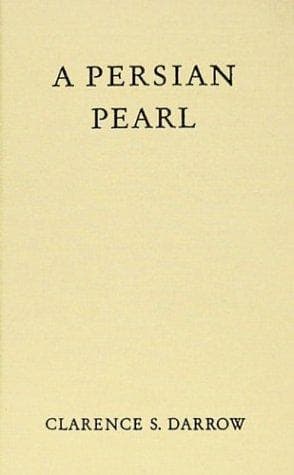
It is nearly eight hundred years since Omar Khayyam, the Persian
astronomer, philosopher, and poet, mused and wrote upon the uncertainty
of life, the eternity of time and the mutability of human things. Since
the rose bush was planted above his grave, the material world has been
almost made anew. Art and literature have given countless treasures to
the earth, and science has solved its mysteries without end. But the
riddles of existence—the problems of life, the deep heart of the
universe, the cause and purpose and end of all, are mysteries as dark
and inscrutable as they were eight centuries ago. To quote from the
Rubaiyat:
There was the Door to which I found no Key;
There was the Veil thro’ which I could not see:
Some little talk awhile of Me and Thee
There was—and then no more of Thee and Me.
As Egypt is the newest country visited by the traveler, so this old
book, burnished by the genius of FitzGerald, comes to us as the latest
and profoundest word upon the infinite mysteries which over-shadow human
life. It seems to be the last word, rather than one of the first, spoken
to the perplexed soul of man, calling him from the vain pursuit of
vanities, and asking what all of it is about.
To an egoistic, boasting age and nation, this message, coming from a far
off time and a distant land, reminds us that all wisdom is garnered
neither now nor here. This Persian Pearl remained unpolished for more
than seven hundred years. It was left for Edward FitzGerald carefully
and patiently to burnish up the gem, and make it the thing of beauty
that we know.
It may be that research and study would reveal much of the personal
traits and private life of the great Persian philosopher, whose fame has
so outlived his clay, but with these we can have no concern. It is not
important to know his parents, or whether he had a wife or children, or
cattle or lands. All of these are gone and only his work remains. True,
we cannot but reflect on the personality of the poet in whose brain
these great thoughts were born, but we can know the man only by knowing
his works. Some there are who stand at a distance and view the acts of
the imperfect beings, who at the best stumble and grope along the
uncertain path between the cradle and the grave. All the footsteps that
are straight and true are unnoticed as they pass by, but the irregular,
uncertain, shifting tracks stand out alone to mark the character of the
pilgrim, who bore his heavy load the best he could. These forget that
every son of man travels an unbeaten path—a road beset with dangers and
temptations that no other wanderer met; that his footsteps can be judged
only in the full knowledge of the strength and light he had, the burden
that he carried, the obstacles and temptations that he met, and a
thorough knowledge of every open and secret motive that impelled him
here or there.
Public-domain text, read in full here on John Shaqi.
Reviews
Reviews
No reviews yet
Be the first to share your thoughts on this work.
Join the Discussion
Join the discussion
Sign in to leave a comment or review.
Sign InorCreate an account