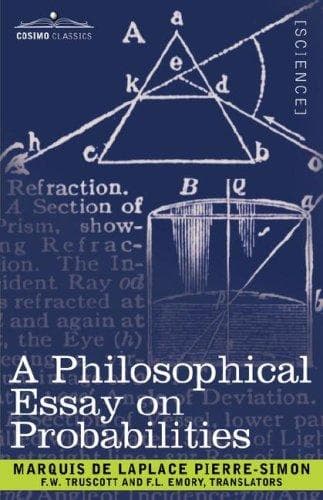
A Philosophical Essay on ProbabilitiesLaplace, Pierre Simon, marquis de
Philosophy
A Philosophical Essay on Probabilities
Laplace, Pierre Simon, marquis de
Probabilities
I ought to make here an important remark. The small uncertainty that the
observations, when they are not numerous, leave in regard to the values
of the constants of which I have just spoken, renders a little uncertain
the probabilities determined by analysis. But it almost always suffices
to know if the probability, that the errors of the results obtained are
comprised within narrow limits, approaches closely to unity; and when it
is not, it suffices to know up to what point the observations should be
multiplied, in order to obtain a probability such that no reasonable
doubt remains in regard to the correctness of the results. The analytic
formulæ of probabilities satisfy perfectly this requirement; and in this
connection they may be viewed as the necessary complement of the
sciences, based upon a totality of observations susceptible of error.
They are likewise indispensable in solving a great number of problems in
the natural and moral sciences. The regular causes of phenomena are most
frequently either unknown, or too complicated to be submitted to
calculus; again, their action is often disturbed by accidental and
irregular causes; but its impression always remains in the events
produced by all these causes, and it leads to modifications which only a
long series of observations can determine. The analysis of probabilities
develops these modifications; it assigns the probability of their causes
and it indicates the means of continually increasing this probability.
Thus in the midst of the irregular causes which disturb the atmosphere,
the periodic changes of solar heat, from day to night, and from winter
to summer, produce in the pressure of this great fluid mass and in the
corresponding height of the barometer, the diurnal and annual
oscillations; and numerous barometric observations have revealed the
former with a probability at least equal to that of the facts which we
regard as certain. Thus it is again that the series of historical events
shows us the constant action of the great principles of ethics in the
midst of the passions and the various interests which disturb societies
in every way. It is remarkable that a science, which commenced with the
consideration of games of chance, should be elevated to the rank of the
most important subjects of human knowledge.
I have collected all these methods in my _Théorie analytique des
Probabilités_, in which I have proposed to expound in the most general
manner the principles and the analysis of the calculus of probabilities,
likewise the solutions of the most interesting and most difficult
problems which calculus presents.
Public-domain text, read in full here on John Shaqi.
Reviews
Reviews
No reviews yet
Be the first to share your thoughts on this work.
Elsewhere in the archive
Join the Discussion
Join the discussion
Sign in to leave a comment or review.
Sign InorCreate an account