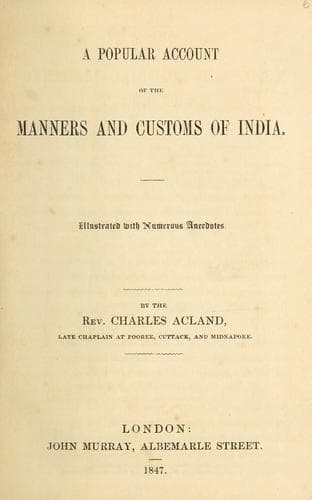
A Popular Account of the Manners and Customs of IndiaAcland, Charles
History
A Popular Account of the Manners and Customs of India
Acland, Charles
India -- Description and travel; India -- Social life and customs
But I must hasten on with my description. Captain R. and I proceeded
into the jungle, where we heard several peacocks; we separated,
creeping along in different directions. Presently I came to an open
space where some pea-fowls were feeding, but we did not succeed in
killing anything. The next evening we went to the same place, when
Captain R. shot a peacock. Towards dusk I was creeping along, when
suddenly I saw what appeared to me a fine peahen. I signed to my
men to be quiet, got as near as I could, fired, and shouted to my
followers to run and pick up the bird, for it was dead. An Indian
servant rarely loses his gravity; but in this instance they could not
restrain themselves when they found that instead of a pea-fowl I had
knocked to pieces the skull of an old cow which had been half-picked
by the vultures; in the dim light I had mistaken it for a bird.
[Sidenote: BHOHONESWAR.]
The next day we proceeded about ten miles farther to Bhalmacottee;
and on the day following, that is Friday, we started at five o'clock
in the morning for Bhohoneswar. On the way we passed the remains of a
very large old fort built of hewn stone. In one of the moats, which
was still full of water, I saw the remains of a pier of a bridge.
Bhohoneswar is a very ancient town, much more so than Pooree: it is
celebrated for containing nine hundred and ninety-nine temples. The
natives say that, had there been a thousand, Juggernat'h would have
taken up his abode here; but as there were not he preferred having a
new temple for himself at Pooree. The ancient city has disappeared,
and the town only consists of a few hundred mud huts. The temples
however remain--some perfect, others in ruins; some facing the street
of the modern town, others half hidden in the surrounding jungle. It
is a wonderful place, and I hardly know how to describe it.
At one extremity of the town is a tank, about half a mile square,
and of a great depth, entirely faced with huge blocks of black
iron-stone. In the centre of this stands a small temple, whilst the
sides are surrounded by others of greater or less size. At the end
next the town an enormous flight of steps leads down to the water,
where hundreds of pilgrims were hastening to wash themselves before
entering the great temple. The farther end is bordered by a dense and
lofty jungle, and in the distance is a splendid background of rugged
hills.
Public-domain text, read in full here on John Shaqi.
Reviews
Reviews
No reviews yet
Be the first to share your thoughts on this work.
Elsewhere in the archive
Join the Discussion
Join the discussion
Sign in to leave a comment or review.
Sign InorCreate an account