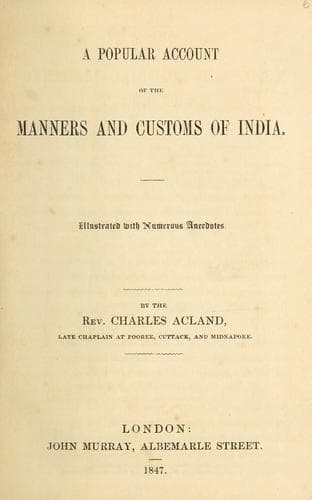
A Popular Account of the Manners and Customs of IndiaAcland, Charles
History
A Popular Account of the Manners and Customs of India
Acland, Charles
India -- Description and travel; India -- Social life and customs
After leaving the burrah tellores (great tank) we walked through
a lane of temples, many of which were ruinous, until we came to
the grand sacred edifice of the place. The form of this, as indeed
of most of the others, is similar to that of Pooree. The temple
of Bhohoneswar is however larger, the principal tower being about
two hundred feet high. Like all the others, it is built entirely
of stone, and every block is most elaborately carved. The various
cornices, of elephants, horses, &c., are as beautifully executed as
if they had been done by the best European artists. The fretwork is
most delicate in its livery, and the many images, though representing
grotesque figures, are admirably carved. The whole forms one mass of
most splendid sculpture.
No description would enable the reader to form any idea of the
magnificence of this building. Many of the blocks of stone are
fifteen, twenty, and twenty-five feet in length, and thick in
proportion. It would be curious to discover by what means they were
ever raised to the height of above one hundred feet. This temple is
still sacred, and we were therefore not allowed to enter it, but we
examined the interior of several of the others. The lofty domes were
evidently constructed by a people who were ignorant of the use of
the arch; they are formed of overlapping stones, approaching nearer
and nearer together until they reach the top, where the whole is
surmounted by one enormous block.
[Sidenote: CUNDEEGURREE.]
We breakfasted in a small tent which we had sent forward to
Bhohoneswar, and then proceeded in our palanquins to Cundeegurree, a
distance of about seven miles. This latter place consists of three
hills surrounded by the most romantic-looking jungle. Our palanquins
were set down in what may be called a forest, at the foot of the
principal hill, and crowned by a small but very pretty white temple.
These hills are perforated in every direction with caves of various
dimensions, and reminded me most forcibly of the ancient Petra. Many
of the caves are inhabited by devotees and priests. The god whom
they worship is quite unknown to our Hindu servants: he is called
Persilat'h, and is the god of the Jains, who were a powerful race
that existed prior to the introduction of the Hindu religion. There
are very few of them now remaining. The god is represented as a naked
man, standing upright, with his arms hanging down by his sides. In
many of the caves are small images of this deity beautifully cut in a
dark-blue stone.
Public-domain text, read in full here on John Shaqi.
Reviews
Reviews
No reviews yet
Be the first to share your thoughts on this work.
Elsewhere in the archive
Join the Discussion
Join the discussion
Sign in to leave a comment or review.
Sign InorCreate an account