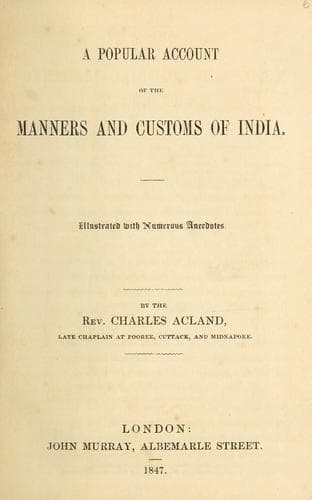
A Popular Account of the Manners and Customs of IndiaAcland, Charles
History
A Popular Account of the Manners and Customs of India
Acland, Charles
India -- Description and travel; India -- Social life and customs
I have mentioned the manner in which Europeans are apt to alienate
the affections of the natives; I will now give you an instance of
the way in which the Government seek to conciliate them. It must be
remembered that salt is a Government monopoly, that is, no person
is allowed to prepare or sell it except by the appointment of
Government. The cost to them is about eight annas, or one shilling,
per maund of eighty pounds; they sell it for four rupees, or eight
shillings, for the same quantity; and yet so necessary is it to
the natives, that, if any man does not buy the usual quantity of
Government, which is, I believe, about half a seer, or one pound,
a-month, for each individual, he is brought by the police before a
magistrate and sent to gaol, on the presumption that, as he does not
purchase salt, he must smuggle it.
Now the salt-manufacturers receive a portion of their pay beforehand,
and the remainder when the salt is ready. They belong mostly to the
poorest classes, and their mode of working is very simple, merely
collecting the sea-water, and then suffering it to evaporate in the
sun. When they receive the first portion of their pay, they are told
how much they will receive per maund, for the price varies slightly
in different years. Last year they were promised a certain sum; I am
not exactly sure how much, but say eight annas per maund; and when
they came to the salt-agent for their money, they found that an order
had arrived from Government reducing the promised pay to six and a
half annas per maund. Of course they were excessively angry, and
utterly astonished; for one strong idea with the natives is, that an
Englishman will never tell an untruth. I happened to be present at
the time; it occurred at Pooree, in the neighbourhood of which are
some of the principal salt-works, if I may use so dignified a term.
The proper course for these poor people to have taken would have
been, to have brought an action against Government for breach of
contract; but this they could not possibly afford. However, the
magistrates of Pooree sent a strong remonstrance to Government, and
the consequence was, that they authorized the salt-agent this year to
renew the contracts at the higher price, much to the delight of the
poor salt-manufacturers, who still lost a part of the promised price
of last year; yet it is scarcely to be credited that, before the time
for the second payment arrived, another order was sent down, reducing
the price as they did last year, and thus again defrauding the poor
wretches of part of their small pittance, for defrauding it is in the
truest sense of the word. All these things are managed by four or
five men, who compose what is called the Salt Board.[6] I may mention
that the salt-workers have been sadly disturbed this year by the
number of tigers. The natives sometimes keep the claws of those which
they are so fortunate as to kill, to make charms to keep off mischief.
[Sidenote: RELIGION OF THE BRAHMINS--JUGGERNAT'H.]
Public-domain text, read in full here on John Shaqi.
Reviews
Reviews
No reviews yet
Be the first to share your thoughts on this work.
Elsewhere in the archive
Join the Discussion
Join the discussion
Sign in to leave a comment or review.
Sign InorCreate an account