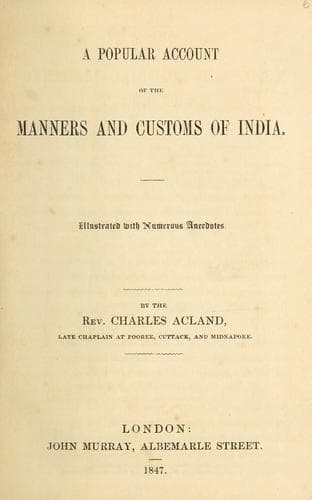
A Popular Account of the Manners and Customs of IndiaAcland, Charles
History
A Popular Account of the Manners and Customs of India
Acland, Charles
India -- Description and travel; India -- Social life and customs
And now I must describe Juggernat'h. To the temple are attached
about _four thousand_ priests and servants. Of these one set are
called Pundahs. In the autumn of every year they start on a journey
through India, preaching in every town and village the advantages
of a pilgrimage to Juggernat'h; after which they conduct to Pooree
large bodies of pilgrims for the Rath Justra, or Car Festival, which
takes place in May or June--the precise time depends on the moon, as
does the time of our Easter. This is the principal festival, and the
number of devotees varies from about 80,000 to 150,000. About five
years ago there were present, on one occasion, not less than 250,000;
but that numerous meeting was owing to some peculiar sanctity which
is supposed to be diffused once in 200 years. But I ought to have
commenced with some account of Juggernat'h himself. He represents
the ninth incarnation of Vishnoo. I have often wondered whether the
Hindu religion may not, in some portions, be taken remotely from
the Christian. One name of Vishnoo is Chrishna; one appellation of
Juggernat'h is Sri Teo. This Teo, as Chrishna, became incarnate
whilst very young; he was sought after by a king to put him to
death. Many children were killed, but he was removed from place to
place in safety. He was born amongst the shepherds. The Hindus look
for a tenth incarnation, when he shall unite all the world in one
religion, and himself reign over them. I believe I am correct in
giving these as points of faith amongst the Brahmins; and when we
consider that the Hindu religion was probably established long after
St. Thomas and St. Bartholomew had visited India, it certainly seems
allowable to suppose that some portion of the Christian teaching
became mingled with the doctrines of the Hindus. There is one
objection to this supposition, namely, that Vishnoo is represented to
have lived a very wicked and immoral life while on earth.
No European, Mussulman, or low-caste Hindu is admitted into the
temple; we can, therefore, only speak on hearsay of what goes on
inside. The idol itself is renewed every twelve years; it consists
of a mere block of sacred wood, in the centre of which is said to be
concealed a fragment of the original idol, which was fashioned by
Vishnoo himself. The features and all the external parts are formed
of a mixture of mud and cowdung painted. Every morning the idol
undergoes his ablutions; but as the cowdung and paint would not stand
the washing, the priests adopt a very ingenious plan--they hold a
mirror in front of the image, and wash his reflection. Every evening
he is put to bed; but as the idol is very unwieldy, they place the
bedstead in front of him; on that they lay a small image, lock the
door, and leave him to come down himself, if he can.
Public-domain text, read in full here on John Shaqi.
Reviews
Reviews
No reviews yet
Be the first to share your thoughts on this work.
Elsewhere in the archive
Join the Discussion
Join the discussion
Sign in to leave a comment or review.
Sign InorCreate an account