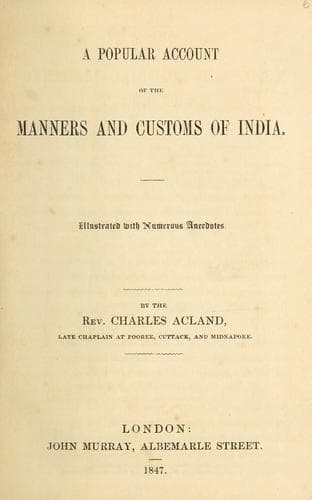
A Popular Account of the Manners and Customs of IndiaAcland, Charles
History
A Popular Account of the Manners and Customs of India
Acland, Charles
India -- Description and travel; India -- Social life and customs
We are making rather a large flower-garden between the house and the
river. The wages to a good gardener are about two pence a-day--to a
coolie, or labourer, a penny three farthings. My mollee, or gardener,
is a very good one; but I must explain what we mean by a good
gardener. It signifies neither more nor less than a good thief. I
plan my garden and lay it out, showing the man where the paths are to
be, where the beds, and where the lawns. Within a few days after it
is laid out I expect to find it tolerably full of flowers and shrubs.
Where they come from I do not know: you cannot purchase any such
things here. Of course, then, everything must come from the gardens
of my neighbours. In England this would be considered, and would in
fact be, a very dishonest mode of proceeding; but in India it is the
custom.
The mollees have the charge of the gardens, and they mutually supply
one another. If after a time I should have anything very choice in my
garden, my mollee would give cuttings or small plants of it to any of
the other mollees who wished for them, and thus every garden would
be improved. A person must be very churlish indeed to interfere with
this system of general accommodation, which in the end is equally
advantageous to all. The system, however, is liable to abuse, and
therefore I do not think I altogether approve of it myself. I was
once dining with a young officer, and we had some remarkably fine
peas. After praising them, I observed that I did not know he had a
garden. "Why, no," he replied, laughing; "but I keep a very good
gardener." Now this was decidedly most unjust. This young man would
not be at the trouble or expense of a garden himself, but chose to
take an unfair advantage of the industry and liberality of others. I
was not at all surprised to hear, shortly afterwards, that a court
of inquiry had been sitting to examine into the circumstances of a
most dishonourable action which he had committed, and for which, if
it had not been for the leniency of his commanding officer, he would
most probably have been cashiered.
[Sidenote: CRUEL TREATMENT OF SERVANTS.]
Public-domain text, read in full here on John Shaqi.
Reviews
Reviews
No reviews yet
Be the first to share your thoughts on this work.
Elsewhere in the archive
Join the Discussion
Join the discussion
Sign in to leave a comment or review.
Sign InorCreate an account