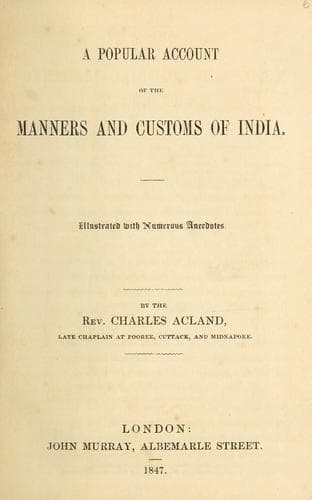
A Popular Account of the Manners and Customs of IndiaAcland, Charles
History
A Popular Account of the Manners and Customs of India
Acland, Charles
India -- Description and travel; India -- Social life and customs
I think I have told you how cruelly some of the people here beat
their servants. I was standing with an officer in the porch of his
house when I was last at Midnapore, when his syce, or groom, brought
his horse to the door. Captain L. turned to me, and said, "I have
not given that fellow a thrashing for a long time, and he'll forget
what it feels like, and grow lazy." Now the fact was, the man was
so attentive and industrious that Captain L. could not possibly
find any fault with him. However, he went down the steps, and, on
the pretence that the man did not hold his horse properly, gave him
several violent blows on the face and head, kicked him three or four
times with all his force, and struck him on the back with a two-foot
rule with such violence that the man was obliged to have his back
plastered and bandaged up: and all this without the slightest fault
on the part of the servant.
Much as has been said about slavery, I do not believe that any of
the slaves in Jamaica were ever worse treated than are the servants
of some of our officers here. The excuse is, that it is impossible
to manage the Hindus without the whip; but I never use it, and I am
certainly quite as well served by all, excepting two. With these I
am going to part, for they have been spoiled by living with a very
violent man. I will give you an instance of the punishments I employ.
My sirdar always goes home to his supper at nine o'clock. The other
evening, after he was gone, I found that he had neglected to get the
night-lamp ready, so I was obliged to do it myself. The following
morning, instead of thrashing him, I made no observation whatever on
the subject; but at nine o'clock in the evening, when he came to ask
whether he might go home, I said, "You did not bring the night-lamp
last night; I may want something else that is not ready, so for the
next week you will not go till eleven." This was a great punishment
to him, and yet it did not degrade either the man or myself as a
beating would do. At the same time I fully admit that the natives,
by their slowness and inactivity, are sometimes very provoking; but
surely that is no excuse to the Christian who gives way to angry
feelings.
FOOTNOTE:
[4] Plenty of barley is grown in Bhootan.
Cuttack, October 12, 1843.
I returned to Cuttack yesterday from Midnapore. It was a most
wretched journey, raining incessantly--not such mild gentle rain as
you have in England, but regular blinding torrents. The roads were so
desperately bad that, although I engaged two extra bearers at each
stage, yet each day's journey of fifty miles took me twenty-four
hours instead of fifteen. My last day's journey was from Barrapore to
Cuttack--fifty miles. I started at two in the afternoon, and arrived
at home at half-past two the next day.
Public-domain text, read in full here on John Shaqi.
Reviews
Reviews
No reviews yet
Be the first to share your thoughts on this work.
Elsewhere in the archive
Join the Discussion
Join the discussion
Sign in to leave a comment or review.
Sign InorCreate an account