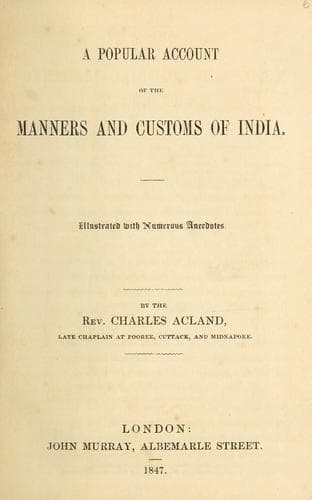
A Popular Account of the Manners and Customs of IndiaAcland, Charles
History
A Popular Account of the Manners and Customs of India
Acland, Charles
India -- Description and travel; India -- Social life and customs
The Serjeant, with one native, now proceeded down a narrow path which
led into the jungle. He had not been gone more than five minutes
when the Ensign heard the report of a gun, and the next instant the
Serjeant rushed out of the jungle, without his hat, without his gun,
with his mouth wide open, eyes staring, and hair all on end. "What's
the matter, Serjeant?" cries the Ensign. "A tiger, sir," says the
other, without stopping. "A tiger?" "Ay." Down goes the Ensign's gun
over his camp-stool, and off he starts after the Serjeant as fast as
his legs can carry him. "Hulloh!" exclaims the Lieutenant, as they
came rushing towards him: "why, what's in the wind now?" "A tiger! a
tiger!" they shout. Down goes the Lieutenant's gun, and he quickly
joins in the race. "What in the world are you all after?" cries the
Captain, as they came to where he was comfortably sitting, drinking
a bottle of beer, and smoking a cigar. "A tiger! a tiger! a tiger!"
is again the reply. "Pooh, pooh, nonsense!" said the Captain, moving
slowly towards his horse. "Nonsense!" answered the fugitives; "we
tell you there is a tiger down there: go and see yourself." "No, I
am tired," says the Captain; "I shall go home." And he jumped on
his horse, and, followed by his brave comrades, galloped back to
Cuttack. How the natives did grin and chuckle. They, too, had seen
the frightful monster, and knew that it was a poor harmless jackal
which had put to flight the Captain, and the Lieutenant, and the
Ensign, and the Serjeant!!!
But there is moral to this tale. Another officer asked the Serjeant
afterwards why he ran away? The answer was, that he ran at first
because he was alone and unsupported, and that he ran afterwards
because he saw the officers run. And this will ever be the case. If
the officers show a firm front, so will the men: if the officers
waver or hesitate, it will naturally strike a panic into the minds of
those who are accustomed to look up to them for guidance. Remarkable
instances of both these positions we have recently had at Jellalabad
and Kabul.
[Sidenote: COSTUME REGULATIONS.]
I start on Friday next for Balasore. I go principally for the sake of
exercise and shooting. There are a great many bears there. My wife
has just hired a new woman-servant. She is of the Ooriah Mehanee
caste, and therefore may not wear petticoats, but only the common
native dress. Now, all ladies like their own personal servants to
wear petticoats; but here it is so strictly forbidden, that the
woman, if she were once to put them on, would be deserted by her
husband and children, and never be suffered to eat with any of her
tribe. But then the Hindu law, whilst it is thus severe on any breach
of caste, provides an easy mode of getting over the difficulty. My
wife gives the woman eight shillings: the woman gives half of this
to the priest, and with the other half she provides a feast for her
tribe. After this she may wear her petticoats in peace and security.
Public-domain text, read in full here on John Shaqi.
Reviews
Reviews
No reviews yet
Be the first to share your thoughts on this work.
Elsewhere in the archive
Join the Discussion
Join the discussion
Sign in to leave a comment or review.
Sign InorCreate an account