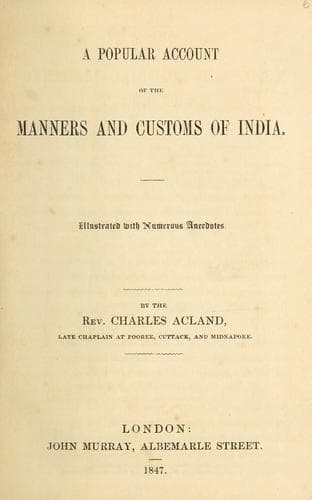
A Popular Account of the Manners and Customs of IndiaAcland, Charles
History
A Popular Account of the Manners and Customs of India
Acland, Charles
India -- Description and travel; India -- Social life and customs
Barripore, January 5, 1844.
[Sidenote: MIRAGE AT POOREE.]
There is one part of the sands at Pooree, on which if you stand
about the middle of the day, and look towards the north, you are
surprised to observe in the distance an English town. You see several
three-storied houses, with doors and windows: interspersed here
and there are several very English-looking trees; and at a short
distance, standing on a small hill, you see the ruins of a large
castle, with the green ivy clinging to it in many parts. Often have I
stood and gazed upon this scene, for it reminds me of dear England.
And yet, if you go to the place, what do you suppose you find?
Nothing but one long flat bed of loose sand, without one vestige of a
tree.
The appearance is caused solely by the refraction of the rays of
light. To explain this I will give an example. If you hold a stick so
that the lower part is in the water and the upper part in the air,
the stick will appear to be bent at the point where it passes the
surface of the water; or, place a shilling in a cup or basin, so that
you cannot see it because the side of the cup hides it from you, fill
the cup with water, and then you will see the shilling, although it
is still in the same spot it was in before. This bending of the rays
is what is called refraction, and is caused by the rays passing out
of one transparent thing into another which is more or less dense
than the first. I think that the cause of the mirage at Pooree is
this. Hot air is less dense than cold air. The steam which comes
from a kettle is still water, but it occupies a much larger space
than the water did. One kettle of water will give much more than a
kettlefull of steam, so that it is evident that the heat has made the
water occupy a much larger quantity of space. Still the steam is only
water; therefore it must be much less dense than cold water. If you
filled a saucepan with water, and fastened the lid down, so that no
steam could escape, it would burst it: the particles of heat cause
the particles of water to be less closely connected together. But
that is a subject too abstruse for this work.
Well, hot air, like hot water, is less dense than cold air; also
water is more dense than air. You could not run along as quickly in
the water as you could in the air; you could not strike a person with
your hand under water hard enough to hurt him; and this is because
the water is more dense or solid than air: therefore, air with a good
deal of moisture in it is more dense than when dry. But along the hot
sands of Pooree, close to the sea-shore, there must be a great deal
of heat and also a great deal of moisture.
Public-domain text, read in full here on John Shaqi.
Reviews
Reviews
No reviews yet
Be the first to share your thoughts on this work.
Elsewhere in the archive
Join the Discussion
Join the discussion
Sign in to leave a comment or review.
Sign InorCreate an account