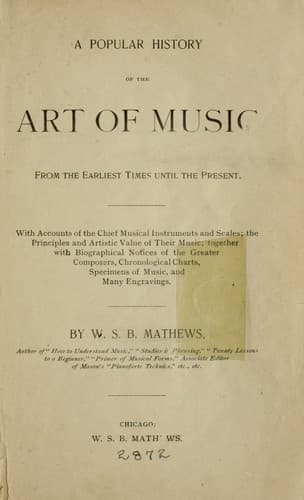
A Popular History of the Art of Music: From the Earliest Times Until the PresentMathews, W. S. B. (William Smythe Babcock)
History
A Popular History of the Art of Music: From the Earliest Times Until the Present
Mathews, W. S. B. (William Smythe Babcock)
Music -- History and criticism
The art of organ playing found its next great exponents in Holland and
Germany, all of them having been pupils of the Venetian master. The
most celebrated of these, considered purely as an organist, was Jean
Pieters Swelinck (1560-1621), who was born at Deventer in Holland, and
died at Amsterdam. He was more celebrated as a performer and
improviser than for the instrumental pieces he published. Among his
pupils was the celebrated Samuel Scheidt (1587-1654), organist at
Halle, who is memorable as the first who made artistic use of the
chorale. Scheidt is also famous as the author of a book upon organ
tabulature, or the notation for organ, which in Germany at this period
was different from that of the piano, and in fact much resembled the
tabulature for the lute, from which it was derived. It consists of a
combination of lines and signs, by the aid of which the organist was
supposed to be capable of deciphering the intentions of the composer.
No especial importance appears to have been attached to the difference
of notation for instruments and voices in this period. And in fact,
until our own times certain instruments, the viola, for example, have
had their own notation, different from the voices, and different from
that of other instruments. Another celebrated German organist of this
period was Johann Hermann Schein, who, with Scheidt and Swelinck,
constituted the three great German musical S's of the sixteenth
century. Schein (1586-1630) was appointed cantor of the Leipsic St.
Thomas school in 1615, and worked there as above. His numberless
compositions are more free in style than the average of the century,
and a number of them are distinctly secular. Nevertheless, in the
development of instrumental music he had but small part, not being one
of the highly gifted original geniuses who impress themselves upon
following generations. The great German master of this period was
Schuetz, chapel master at Dresden, whose career forms part of the
story of the oratorio, a form of music which he had so large a share
in shaping into its present form.
[Illustration: Fig. 49.
SAMUEL SCHEIDT.]
II.
Public-domain text, read in full here on John Shaqi.
Reviews
Reviews
No reviews yet
Be the first to share your thoughts on this work.
Elsewhere in the archive
Join the Discussion
Join the discussion
Sign in to leave a comment or review.
Sign InorCreate an account