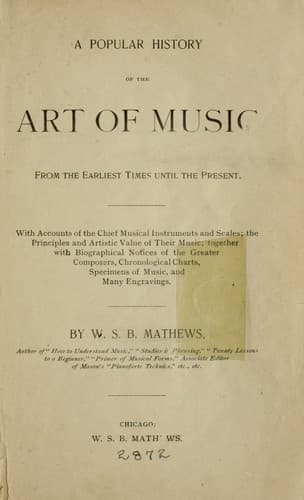
A Popular History of the Art of Music: From the Earliest Times Until the PresentMathews, W. S. B. (William Smythe Babcock)
History
A Popular History of the Art of Music: From the Earliest Times Until the Present
Mathews, W. S. B. (William Smythe Babcock)
Music -- History and criticism
In order to come once more into the path of musical empire, we must
return again to Italy, where there was an organist at St. Peter's, who
had in him the elements of greatness and originality. Girolamo
Frescobaldi (1587-1640) was organist of St. Peter's at Rome from
1615. His education had been in part acquired in Italy, and in part in
the Netherlands. As a virtuoso he attained an extraordinary success,
and one of his recitals is reputed to have been attended by as many as
30,000 people. He distinguished himself as composer no less than as
organist, and particularly by his compositions in free style. His
Ricerari, Concertos and Canzones were all protests against the bondage
of instrumental music to the fetters of vocal forms. It was the
compositions of this master, together with those of Froberger, that
Sebastian Bach desired to have, and which, in fact, he stole out of
his brother's book case, and copied in the moonlight nights.
It would take us too far were we to enumerate all the composers who
distinguished themselves in this century, no one of them succeeding in
composing anything satisfactory to this later generation, but all
contributing something toward the liberation of instrumental music,
and all adding something to its too limited resources. Among these
names were those of Johann Kasper Kerl, organist at St. Stephen's
church in Vienna, who, after having served with distinction at Munich,
returned later and died at Vienna in 1690. Another of these German
masters, also one of those whose compositions Bach wished to study,
was Johann Pachelbel, of Nuremberg (1635-1706). In 1674 he was
assistant organist at Vienna, in 1677 organist at Eisenach, and soon
back to Nuremberg a few years later. His multifarious works for organ,
among which we find a variety of forms, were perhaps the chief model
upon which Sebastian Bach formed his style. He especially excelled in
improvising choral variations, and in fanciful and musicianly
treatment of themes proposed by the hearer. Yet another name of this
epoch, that of George Muffat, is now almost forgotten. He studied in
France, and formed his style upon that of the French. A later master,
also very influential in the style of Sebastian Bach, was Dietrich
Buxtehude (1637-1707). For nearly forty years he was organist at the
Church of St. Mary at Luebeck, where he was so celebrated that the
young Sebastian Bach made a journey on foot there in order to hear and
master the principles of his art. Buxtehude wrote a great number of
pieces in free style for the organ, and, while his works have little
value to modern ears, there is no doubt that this master was an
important influence upon the enfranchisement of instrumental music.
Among all these Netherlandish organists few are better known by name
at the present day than Johann Adam Reinken (1623-1722), who was born
at Deventer, Holland, and after the proper elementary and finishing
studies, succeeded his master, Scheidemann, as organist at Hamburg.
Public-domain text, read in full here on John Shaqi.
Reviews
Reviews
No reviews yet
Be the first to share your thoughts on this work.
Elsewhere in the archive
Join the Discussion
Join the discussion
Sign in to leave a comment or review.
Sign InorCreate an account