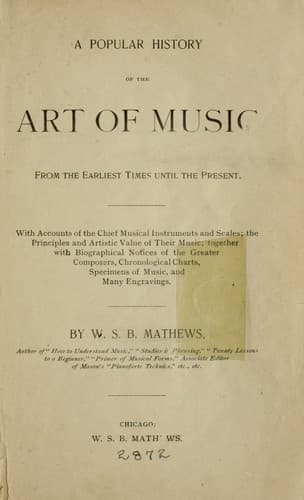
A Popular History of the Art of Music: From the Earliest Times Until the PresentMathews, W. S. B. (William Smythe Babcock)
History
A Popular History of the Art of Music: From the Earliest Times Until the Present
Mathews, W. S. B. (William Smythe Babcock)
Music -- History and criticism
Here his fame was so great that the young Bach made two journeys there
on foot, in order to hear him. He was a virtuoso of a high order, and
his style exercised considerable influence over that of Bach.
[Illustration: Fig. 50.
JOHANN ADAM REINKEN.]
III.
Return we now to Italy, where the violin led also to an important
development of instrumental music, having in it the promise of the
best that we have had since. In Fusignano, near Imola, was born in
1653 Archangelo Corelli, who became the first of violin virtuosi, and
the first of composers for the instrument, and for violins in
combination with other members of the same family, and so of our
string quartette. He died in 1713 at Rome. Of his boyhood there is
little known. About 1680 he appears in high favor at the court of
Munich. In 1681 he was again in Rome, where he appears to have found a
friend in Cardinal Ottoboni, in whose palace he died. His period of
creative activity extended from 1683, when he began the publication of
his forty-eight three-voiced sonatas, for two violins, in four numbers
of twelve sonatas each. He also composed many other sonatas for the
violin, for violin and piano, and for other instruments. These
epoch-marking works are held in high esteem at the present time, and
are in constant use for purposes of instruction.
Meanwhile the orchestra had been steadily enriched through the
competition of successive operatic composers, each exerting himself to
produce more effect than the preceding. In this way new combinations
of tone color were contrived, and now and then introduced in a
fortunate manner, and effects of greater sonority were attained
through the greater number of instruments, and the more expert use of
those they had. In the present state of knowledge it would be very
difficult, if not impossible, to trace the successive steps of this
progress, and to give proper credit to each composer for his own
contribution to the general stock. At best, the orchestra at the end
of this century was somewhat meager. The violin and the other members
of its family had taken their places somewhat as we now have them, but
the number of basses and tenors was much less than at present, their
place being filled by the archlute and the harpsichord. The trumpet
was occasionally employed, the flute, the oboe, and very rarely the
trombone. The conductor at the harpsichord, playing from a figured
bass, filled in chords according to his own judgment of the effect
required. Nothing approaching the smoothness and discreet coloration
of the orchestra of the present day, or even of the Haydn orchestra,
existed at this time. The violin players were very cautious about
using the second and third "positions," but played continually with
their hands in the first position. This part of the music, therefore,
wholly lacked the freedom which it now has, and the whole progress of
this century was purely apprentice work in instrumental music, its
Public-domain text, read in full here on John Shaqi.
Reviews
Reviews
No reviews yet
Be the first to share your thoughts on this work.
Elsewhere in the archive
Join the Discussion
Join the discussion
Sign in to leave a comment or review.
Sign InorCreate an account