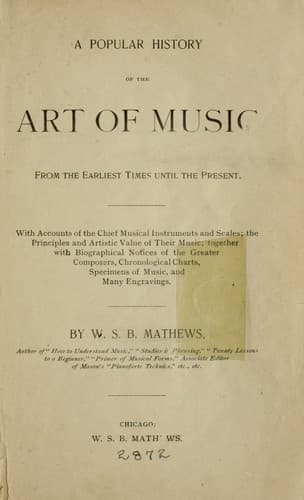
A Popular History of the Art of Music: From the Earliest Times Until the PresentMathews, W. S. B. (William Smythe Babcock)
History
A Popular History of the Art of Music: From the Earliest Times Until the Present
Mathews, W. S. B. (William Smythe Babcock)
Music -- History and criticism
Upon the whole, all the improvements of the time arrange themselves
into two categories, namely: The better proportion, contrast, and more
agreeable succession of moments in art works; and, second, the more
ample means for intense expression. In the department of form, indeed,
there was a very important transition made between the first half of
the century and the last. The typical form of the first part of this
division was the fugue, which came to a perfection under the hands of
Bach and Haendel, far beyond anything to be found in the form
previously. The fugue was the creation of this epoch, and while based
upon the general idea of canonic imitation, after the Netherlandish
ideal, it differed from their productions in several highly
significant respects. While all of a fugue is contained within the
original subject, and the counter-subject, which accompanies it at
every repetition, it has an element of tonality in it which places it
upon an immensely higher plane of musical art than any form known, or
possible, before the obsolescence of the ecclesiastical modes.
Moreover, the fugue has opportunities for episode, which enable it to
acquire variety to a degree impossible for any form developed earlier;
and which, when these opportunities were fresh, afforded composers a
field for the display of fancy which was practically free. This, one
may still realize by comparing the different fugues in Bach's "Well
Tempered Clavier" with each other, and with those of any other
collection. It is impossible to detect anywhere the point where the
inspiration of the composer felt itself bound by the restrictions of
this form. It was for Bach and Haendel practically a free form. And the
few other contemporaneous geniuses of a high order either experienced
the same freedom in it, or found ways of evading its strictness by the
production of various styles of fancy pieces, which, while conforming
to the fugue form in their main features, were nevertheless free
enough to be received by the musical public of that day with
substantially the same satisfaction as a fantasia would have been
received a century later. Roughly speaking, Bach and Haendel exhausted
the fugue. While Bach displayed his mental activity in almost every
province of music, and like some one since, of whom it has been much
less truthfully said, "touched nothing which he did not adorn," he was
all his life a writer of fugues. His preludes are not fugues, and
their number almost equals that of the fugues; but the operative
principles were not essentially different--merely the applications of
thematic development were different. Yet strange as it may seem,
within thirty years from his death it became impossible to write
fugues, and at the same time be free. Why was this?
Public-domain text, read in full here on John Shaqi.
Reviews
Reviews
No reviews yet
Be the first to share your thoughts on this work.
Elsewhere in the archive
Join the Discussion
Join the discussion
Sign in to leave a comment or review.
Sign InorCreate an account