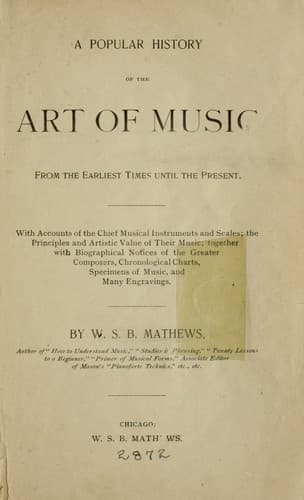
A Popular History of the Art of Music: From the Earliest Times Until the PresentMathews, W. S. B. (William Smythe Babcock)
History
A Popular History of the Art of Music: From the Earliest Times Until the Present
Mathews, W. S. B. (William Smythe Babcock)
Music -- History and criticism
A new element came into music, incompatible with fugue, requiring a
different form of expression, and incapable of combination with fugue.
That element was the people's song, with its symmetrical cadences and
its universal intelligibility. Let the reader take any one of the
Mozart sonatas, and play the first melody he finds--he will
immediately see that here is something for which no place could have
been found in a fugue, nor yet in its complement, the prelude of
Bach's days. The same is true of many similar passages in the sonatas
of Haydn. Music had now found the missing half of its dual nature. For
we must know that in the same manner as the thematic or fugal element
in music represents the play of musical fantasy, turning over musical
ideas intellectually or seriously; so there is a spontaneous melody,
into which no thought of developing an idea enters. The melody flows
or soars like the song of a bird, because it is the free expression,
not of musical fantasy, as such (the unconscious play of tonal fancy),
but the flow of _melody_, _song_, the soaring of spirit in some one
particular direction, floating upon buoyant pinions, and in directions
well conceived and sure. The symmetry of the people's song follows as
a natural part of the progress. The spontaneous element of the music
of the northern harpers now found its way into the musical productions
of the highest geniuses. Henceforth the fugue subsides from its
pre-eminence, and remains possible only as a highly specialized
department of the general art of musical composition, useful and
necessary at times, but nevermore the expression of the unfettered
fancy of the musical mind.
The discovery of the secret of musical contrast, in the types of
development, the _thematic_ and the _lyric_, led to the creation of a
new form, in which they mutually contrast with and help each other.
That form was the Sonata, which having been begun earlier, was
developed further by the sons of Bach, but which received its
characteristic touches from the hands of Haydn and Mozart. This was
the crowning glory of the eighteenth century--the sonata. A form had
been created, into which the greatest of masters was even then
beginning to breathe his mighty soul, producing thereby a succession
of master works, which stand without parallel in the realm of music.
CHAPTER XXIII.
JOHN SEBASTIAN BACH.
Public-domain text, read in full here on John Shaqi.
Reviews
Reviews
No reviews yet
Be the first to share your thoughts on this work.
Elsewhere in the archive
Join the Discussion
Join the discussion
Sign in to leave a comment or review.
Sign InorCreate an account