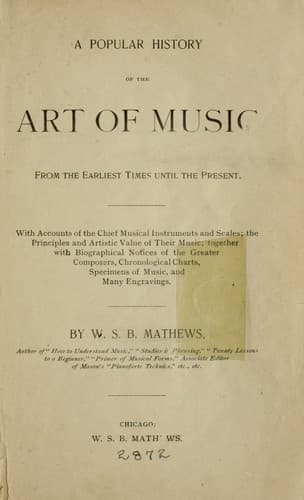
A Popular History of the Art of Music: From the Earliest Times Until the PresentMathews, W. S. B. (William Smythe Babcock)
History
A Popular History of the Art of Music: From the Earliest Times Until the Present
Mathews, W. S. B. (William Smythe Babcock)
Music -- History and criticism
The life of Bach need not long detain us. A musician of the tenth
generation, member of a family which occupies a liberal space in
German encyclopedias of music, art and literature, Sebastian Bach led
the life of a teacher, productive artist and virtuoso, mainly within
the limits of the comparatively unimportant provincial city of
Leipsic. His three wives in succession and his twenty-one children
were the domestic incidents which bound him to his home. Here he
trained his choir, taught his pupils, composed those master works
which modern musicians try in vain to equal, and the even tenor of his
life was broken in upon by very few incidents of a sensational kind.
We do not understand that Bach was a virtuoso upon the violin,
although no other master has required more of that greatest of musical
instruments. Upon the piano and organ the case is different. Bach's
piano was the clavier, upon which he was the greatest virtuoso of his
time. His touch was clear and liquid, his technique unbounded, and his
musical fantasy absolutely without limit. Hence in improvisation or in
the performance of previously arranged numbers he never failed to
delight his audience. It was the same upon the organ. The art of
obligato pedal playing he brought to a point which it had never before
reached and scarcely afterward surpassed. He comprehended the full
extent of organ technique, and with the exception of a few tricks of
quasi-orchestral imitation, made possible in modern organs, he covered
the entire ground of organ playing in a manner at once solid and
brilliant. Many stories are told of his capacity in this direction,
but the general characterization already given is sufficient. He was a
master of the first order. The common impression that he played
habitually upon the full organ is undoubtedly erroneous. He made ample
use of registration to the fullest extent practicable on the organs of
his day.
Public-domain text, read in full here on John Shaqi.
Reviews
Reviews
No reviews yet
Be the first to share your thoughts on this work.
Elsewhere in the archive
Join the Discussion
Join the discussion
Sign in to leave a comment or review.
Sign InorCreate an account