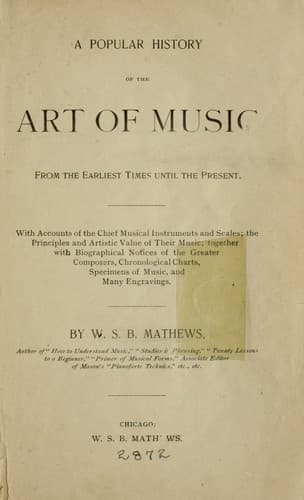
A Popular History of the Art of Music: From the Earliest Times Until the PresentMathews, W. S. B. (William Smythe Babcock)
History
A Popular History of the Art of Music: From the Earliest Times Until the Present
Mathews, W. S. B. (William Smythe Babcock)
Music -- History and criticism
The most remarkable feature of the career of Bach is his productivity
in the line of choral works. As leader of the music in the St. Thomas
church, he had under his control two organs, two choirs, the children
of the school and an orchestra. For these resources he composed a
succession of cantatas, every feast day in the ecclesiastical year
being represented by from one to five separate works. The total number
of these cantatas reaches more than 230. Some of them are short, ten
or fifteen minutes long, but most of them are from thirty to forty
minutes, and some of them reach an hour. Their treasures have been but
imperfectly explored, although most of them are now in print. In the
course of his ministrations at Leipsic he produced five great Passion
oratorios for Good Friday in Holy Week. The greatest of these was the
Passion of St. Matthew, so named from the source of its text. This
work occupies about two hours in performance. It is in two parts, and
the sermon was supposed to intervene. It consists of recitative, arias
and choruses, some of which are extremely elaborate and highly
dramatic. The other Passions are less fortunate. Nevertheless they
contain many beautiful and highly dramatic moments. Bach's oratorios
belong to the category of church works, as distinguished from those
intended for concert purposes. This is seen especially in the
treatment of the chorale, in which he expects the congregation to
co-operate. In one direction Bach was subject to serious limitation.
His knowledge of the voice, and his consideration for its convenience,
were far below the standard of composers of the same time educated in
Italy. In his works, while many passages are very impressive, and
while the melody and harmony are always appropriate to the matter in
hand, the intervals and especially the convenience of the different
registers of the voice are very imperfectly considered, for which
reason his works have not been performed to anything like the extent
to which their musical interest would otherwise have carried them.
This is especially true of the greatest of all, the Passion according
to St. Matthew. It was first performed on Good Friday, 1729, in the
St. Thomas church at Leipsic, and it does not appear to have been
given again until 1829, when Mendelssohn brought it out. Since that
time it has been given almost every year in Leipsic, and more or less
frequently in all the musical centers of the world, but its
elaboration is very great and its vocal treatment unsatisfactory to
solo voices, for which reason it succeeds only under the inspiration
of an artistic and enthusiastic leader. In fact, all the great works
of Bach are more or less in the category of classics, which are well
spoken of and seldom consulted. While, in Beethoven's time, the whole
of the "Well Tempered Clavier" was not thought too much for an
ambitious youngster, at the present time there are few pianists who
play half a dozen of these pieces. The easier inventions for two
Public-domain text, read in full here on John Shaqi.
Reviews
Reviews
No reviews yet
Be the first to share your thoughts on this work.
Elsewhere in the archive
Join the Discussion
Join the discussion
Sign in to leave a comment or review.
Sign InorCreate an account