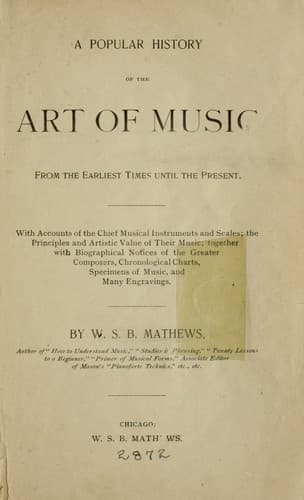
A Popular History of the Art of Music: From the Earliest Times Until the PresentMathews, W. S. B. (William Smythe Babcock)
History
A Popular History of the Art of Music: From the Earliest Times Until the Present
Mathews, W. S. B. (William Smythe Babcock)
Music -- History and criticism
realistic character, and in general he shows himself in his piano
works a man of wide range of mind and extremely vigorous musical
fantasy.
In the department of concertos for solo instruments and orchestra, his
works are very rich. There are a large number for piano, quite a
number for organ, several for two and three pianos, with orchestra,
and various other combinations of instruments, such as two violins and
'cellos, and so on. In these each solo player has an equal chance with
the other, and solos and accompaniment work together understandingly
for mutual ends. The most noticeable feature of his elaborate works is
the rhythm, which is vigorous, highly organized and extremely
effective. In the department of harmony, it is believed by almost all
close observers that no combination of tones since made by any writer
is without a precedent in the works of Bach; the strange chords of
Schumann and Wagner find their prototypes in the works of this great
Leipsic master. Melodically considered, Bach was a genius of the
highest order. Not only did he make this impression upon his own time
and upon the great masters of the next two generations, but many of
his airs have attained genuine popularity within the present
generation, and are played with more real satisfaction than most other
works that we have. This is the more remarkable because from the time
of his first residence in Leipsic when he was only twenty-four years
old he went out of that city but a few times, and heard very little
music but his own. He was three times married, and had twenty-one
children, many of whom were musical. Three of his sons became eminent,
and the principal episode of his later life was his visit to Potsdam,
where his son, Carl Phillip Emanuel, was musician to Frederick the
Great. Here he was received with the utmost informality by the king
and made to play and improvise upon all the pianos and organs in the
palace and the adjacent churches. As a reminiscence of this visit he
produced a fugue upon a subject given by Frederick himself, written
for six real parts. This work was called the "Musical Offering," and
was dedicated to Frederick the Great. In his later years Bach became
blind from having over-exerted his eyes in childhood and in later
life. He died on Good Friday in 1750.
CHAPTER XXIV.
GEO. FREDERICK HAeNDEL.
Public-domain text, read in full here on John Shaqi.
Reviews
Reviews
No reviews yet
Be the first to share your thoughts on this work.
Elsewhere in the archive
Join the Discussion
Join the discussion
Sign in to leave a comment or review.
Sign InorCreate an account