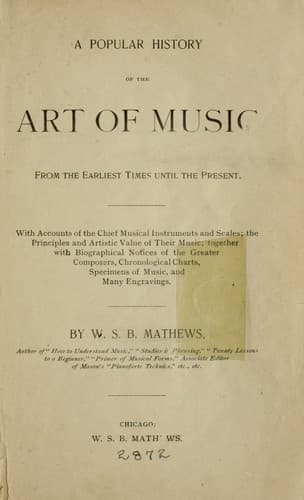
A Popular History of the Art of Music: From the Earliest Times Until the PresentMathews, W. S. B. (William Smythe Babcock)
History
A Popular History of the Art of Music: From the Earliest Times Until the Present
Mathews, W. S. B. (William Smythe Babcock)
Music -- History and criticism
parts, some of the suites, several gavottes, modernized from his
violin and chamber music, and a very few of his other pieces for the
clavier, are habitually played.
It would be unjust to close the account of this great artist without
mentioning what we might call the prophetic element in his works. The
great bulk of Bach's compositions are in two forms, the Prelude and
the Fugue. The fugue came to perfection in his hands. It was an
application of the Netherlandish art of canonic imitation, combined
with modern tonality. In a fugue the first voice gives the subject in
the tonic, the second voice answers in the dominant, the third voice
comes again in the tonic, and the fourth voice, if there be one, again
in the dominant. Then ensues a digression into some key upon what
theorists call the dominant side, when one or two voices give out the
subject and answer it again, always in the tonic and dominant of the
new key. Then more or less modulating matter, thematically developed
out of some leading motive of the subject, and again the principal
material of the theme, with one or more answers. The final close is
preceded by a more or less elaborate pedal point upon the dominant of
the principal key, after which the subject comes in. With very few
exceptions the fugues of Bach are in modern tonality, the major key or
the modern minor, with their usual relatives.
The prelude is a less closely organized composition. Sometimes it is
purely harmonic in its interest, like the first of the "Well Tempered
Clavier." At other times it is highly melodic, like the preludes in C
sharp major and minor of the first book of the Clavier, and, as a
rule, the prelude either treats its motives in a somewhat lyric manner
or dispenses with the melodic material altogether. Thus the prelude
and fugue mutually complete each other. But it is a great mistake to
regard Bach as a writer of fugues alone. He was also very free in
fantasies, and one of his pianoforte works, concerning the origin of
which nothing whatever is known, the "Chromatic Fantasia and Fugue,"
is one of the four or five greatest compositions that exist for this
instrument. The remarkable thing about this fantasia is the freedom of
its treatment and the facility with which it lends itself to virtuoso
handling, as distinguished from the rather limited treatment of the
piano usual in Bach's works. The second part of the fantasia is
occupied by a succession of recitatives of an extremely graphic and
poetic character. Melodically and harmonically these recitatives are
thoroughly modern and dramatic, the latter element being very forcibly
represented by the succession of diminished sevenths on which the
phrases of the recitative end. The fugue following is long, highly
diversified and extremely climactic in its interest. In other parts of
his work Bach has left fantasies of a more descriptive character. He
has, for instance, a hunting scene with various incidents of a
Public-domain text, read in full here on John Shaqi.
Reviews
Reviews
No reviews yet
Be the first to share your thoughts on this work.
Elsewhere in the archive
Join the Discussion
Join the discussion
Sign in to leave a comment or review.
Sign InorCreate an account