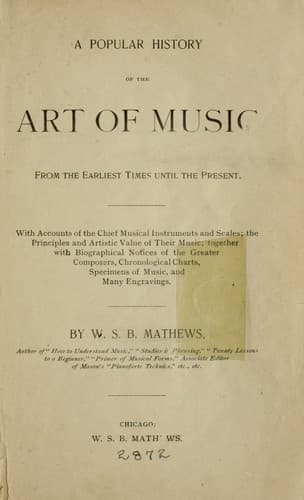
A Popular History of the Art of Music: From the Earliest Times Until the PresentMathews, W. S. B. (William Smythe Babcock)
History
A Popular History of the Art of Music: From the Earliest Times Until the Present
Mathews, W. S. B. (William Smythe Babcock)
Music -- History and criticism
As a tone poet Haydn belonged by no means to the first rank--at least
in so far as the inherent weight and range of his ideas is concerned.
His one claim to musical fame rests upon his graceful manner of
treating a musical idea, and upon the readiness of his invention in
contrasting his themes, to which may be added the sweet and genial
flavor of his music, which in every line shows a pure and childlike
spirit, simple, unaffected, yet deep and true. It was his good fortune
to stand to Mozart and Beethoven in the role of master. Both were in
many ways his superiors, yet both revered him, the one until his own
life went out in the freshness of his youth; the other until when an
old man, having stood upon the very Pisgah tops of the tone world,
full of honors, he spoke of the old master, Haydn, with affection, in
his very last days. Higher testimony than this it would be impossible
to quote. For, in the nature of the case, the composer, Haydn, can
never be judged again by musicians and poets who know so well his aims
and the value of what he accomplished as the two Vienna masters,
Mozart and Beethoven, who were younger than he, yet not too young to
understand the condition of the musical world into which Haydn had
been born, and the musical world as it had become from his living in
it.
[Illustration]
CHAPTER XXVI.
MOZART AND HIS GENIUS.
One of the most engaging personalities, and at the same time one of
the most highly gifted, versatile and richly endowed geniuses who ever
adorned the art of music, was that of Wolfgang Amadeus Mozart
(1756-1791). He was a son of the violin player and musician, Leopold
Mozart, living at Salzburg. At an extremely early age he showed his
love for music by listening to the lessons of his sister. By the time
he was four, his father commenced to give him lessons, and when he was
less than five years old he was discovered one day making marks upon
music paper, which he stoutly maintained belonged to a concerto. The
statement was received with incredulity, but upon carefully examining
the manuscript it was found correctly written, and sensible; but so
difficult as to be impossible to play. Upon the boy's attention being
called to this, he replied, "I call it a concerto because it _is_ so
difficult; they should practice it until they _can_ play it." In
childhood, and indeed all through life, his ear was very sensitive. He
could not bear to hear the sound of a trumpet, and upon his father
seeking to overcome his nervousness by having a trumpet blown in the
room, it threw him into convulsions. The boy was of a most active
mind, interested in everything that went on about him, and eager to
learn in every direction. Nothing came amiss, arithmetic, grammar and
language--he was immediately at home in any subject which he took up.
Music was intuitive to him. So remarkable was his progress, that when
he was yet but six years old his father began to travel with him.
Public-domain text, read in full here on John Shaqi.
Reviews
Reviews
No reviews yet
Be the first to share your thoughts on this work.
Elsewhere in the archive
Join the Discussion
Join the discussion
Sign in to leave a comment or review.
Sign InorCreate an account