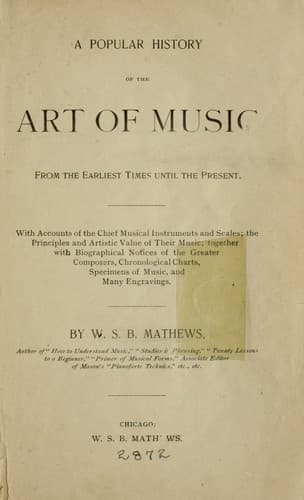
A Popular History of the Art of Music: From the Earliest Times Until the PresentMathews, W. S. B. (William Smythe Babcock)
History
A Popular History of the Art of Music: From the Earliest Times Until the Present
Mathews, W. S. B. (William Smythe Babcock)
Music -- History and criticism
through his influence his father, who had always previously opposed
the order, became a member, during this visit at Vienna. Soon
afterward the father died. For the lodge Mozart wrote much music, both
of a liturgical character and for concerts, and special
entertainments, and in the "Magic Flute" there are many reminiscences
of the order.
A year later he made the acquaintance of the celebrated librettist,
Lorenzo da Ponte, who proposed to adapt Beaumarchais' comedy, "The
Marriage of Figaro," which after some difficulty in obtaining the
consent of the emperor, on account of the objectionable character of
the story, was done, and the work produced at Vienna, May 1, 1786. The
theater was crowded, and many airs were repeated, until at later
performances the emperor prohibited encores. A pleasing scene took
place at the last dress rehearsal. Kelly, who took the parts of Don
Basilio and of Don Curzio, writes: "Never was anything more complete
than the triumph of Mozart and his 'Marriage of Figaro,' to which
numerous overflowing audiences bore witness. Even at the first full
band rehearsal, all present were roused to enthusiasm, and when
Benucci came to the fine passage '_Cherubino Alla Vittoria, Alla
Gloria Militar_,' which he gave with stentorian lungs, the effect was
electric, for the whole of the performers on the stage, and those in
the orchestra, as if actuated by one feeling of delight, vociferated
'_Bravo, Bravo, Maestro. Viva, Viva, grande Mozart_.' Those in the
orchestra I thought would never have ceased applauding, by beating the
bows of their violins against their music desks. And Mozart, I never
shall forget his little animated countenance. When lighted up with the
glowing rays of genius, it is as impossible to describe it as it would
be to paint sunbeams." Yet the success did not improve his position in
money affairs. Soon afterward, however, he was invited to Prague, to
see the success his beautiful work was making there. He was
entertained handsomely, and found the town wild with delight, at the
novelty, the spontaneity and charming quality of his music. He also
gave two concerts there, which were brilliantly successful, and having
been many times recalled he sat down at the piano and improvised for
half an hour, the audience resisting every effort he made to stop.
After returning to Vienna he obtained another libretto from Da Ponte,
that of "_Don Giovanni_," which was produced at Prague, October 29,
1787. It is told, as a characteristic incident of Mozart's method of
working, that the overture of this opera had not been written until
the night before the performance. At every suggestion Mozart answered,
tapping his forehead, "I have it all here." But not a line had been
written. Late at night he set about writing it. His wife made him some
punch, of which he was very fond, and sat with him telling him fairy
stories, in order to keep him awake. Early in the morning the overture
Public-domain text, read in full here on John Shaqi.
Reviews
Reviews
No reviews yet
Be the first to share your thoughts on this work.
Elsewhere in the archive
Join the Discussion
Join the discussion
Sign in to leave a comment or review.
Sign InorCreate an account