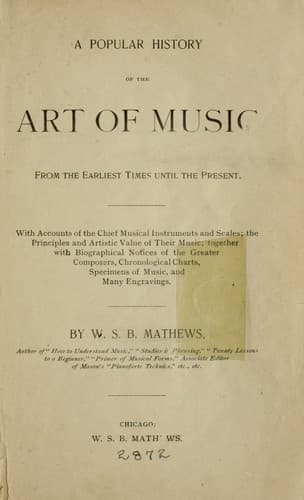
A Popular History of the Art of Music: From the Earliest Times Until the PresentMathews, W. S. B. (William Smythe Babcock)
History
A Popular History of the Art of Music: From the Earliest Times Until the Present
Mathews, W. S. B. (William Smythe Babcock)
Music -- History and criticism
With the attainment of his majority the second period in the life of
this great genius began. Unable to obtain permission from the shabby
prelate for father and son to go together upon an artistic tour, the
father at length decided to send the young man out with his mother,
and in September, 1777, the two started for Paris, traveling in their
own carriage with post horses. Their plan was to give a concert at
every promising town, taking whatever time might be necessary for
working it up in due form. In this way their journey was considerably
prolonged by delays at Munich, Mannheim and Augsburg. At Mannheim,
especially, the incidents of the tour were varied by Mozart's falling
in love with the charming daughter of the theatrical prompter and
copyist, a promising singer, who afterward married happily in quite a
different quarter. At Paris things did not turn out quite so favorably
as the father had anticipated. Most afflicting of all, the mother fell
sick there, and died, so that the son left Paris in September for home
with a far heavier heart than when he entered it. During the most of
1779 and 1780 he remained at Salzburg, fulfilling his duties as
assistant conductor. Then came his first opera in Germany, "_Idomeneo,
Re di Creta_," produced at Munich January 29, 1781. The success of
this work was so decided that it determined Mozart's career as an
operatic composer. A few months later he quarreled with the
archbishop, and the unpleasant connection came to an end. His second
opera, "_Die Entfuehrung aus dem Serail_" ("The Elopement from the
Seraglio"), was produced at Vienna July 16, 1782. This was his first
opera in German. In August of this year he was married to Constance
Weber, younger sister of her who had first enchanted him. The marriage
was congenial in many ways, but as the wife was incapable in money
matters and administration, and Mozart himself careless as a business
man, and in receipt of a small and irregular income, they soon found
themselves in a sea of little troubles, from which the struggling
artist was nevermore free. Only at the last moment, when indeed his
life was all but extinct, did the clouds disappear, and a prospect
open before him, which if he had lived to enjoy it, would have placed
his remaining days in easy circumstances. In 1785 the father visited
his son in Vienna, and upon one of the first days of his stay, there
was a little dinner party at Mozart's house, with Haydn and the two
Barons Todi. In his letter home, Leopold Mozart says that Haydn said
to him: "I declare to you, before God, as a man of honor, that your
son is the greatest composer that I know, either personally or by
reputation; he has taste, and beyond that the most consummate
knowledge of composition." In return for this compliment Mozart
dedicated to Haydn six string quartettes, with a laudatory preface, in
which he says that it was "but his due, for from Haydn I first learned
to compose a quartette." Mozart was an enthusiastic Freemason, and
Public-domain text, read in full here on John Shaqi.
Reviews
Reviews
No reviews yet
Be the first to share your thoughts on this work.
Elsewhere in the archive
Join the Discussion
Join the discussion
Sign in to leave a comment or review.
Sign InorCreate an account