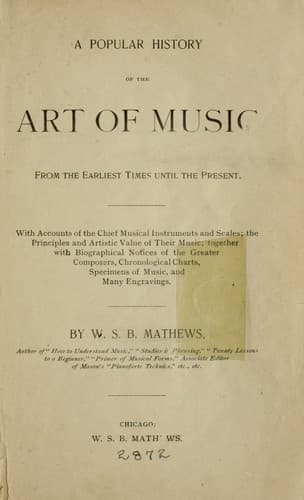
A Popular History of the Art of Music: From the Earliest Times Until the PresentMathews, W. S. B. (William Smythe Babcock)
History
A Popular History of the Art of Music: From the Earliest Times Until the Present
Mathews, W. S. B. (William Smythe Babcock)
Music -- History and criticism
The labors of Haydn and Mozart in the rich field of instrumental music
were followed immediately by those of Ludwig van Beethoven, who was
born at the little town of Bonn, on the Rhine, about twenty miles
above Cologne, in 1770. He died at Vienna, 1827. The years between
these dates were filled with labor and inspiration, beyond those of
any other master. Beethoven's place in music is at the head. Whether
he or Bach ought to be reckoned the very greatest of all the great
geniuses who have appeared in music, is a question which might be
discussed eternally without ever being settled. Considered merely as
an artist capable of transforming musical material in an endless
variety of ways, he would perhaps be placed somewhat lower than Bach;
but considered as a tone poet gifted with the faculty of making
hearers feel as he felt, and see as he saw (with the inner eyes of
tonal sense), no master ought to be placed above him. This is the
general opinion now, of all the world. Taine, the French critic, in
his work on art, names four great souls belonging to the highest order
of genius--Dante, Shakespeare, Michael Angelo and Beethoven. The
company is a good one, and Beethoven rightfully belongs in it. His
early life was wholly different from that of the gifted Mozart. He was
the son of a dissipated tenor singer, and his mother was rather an
incapable person. When the boy was about eleven years old he began to
play the viola in the orchestra. He was already a good pianist, and it
was said of him that he was able to play nearly the whole of the "Well
Tempered Clavier" by heart, and at the age of eleven and a half he was
left in charge during Neefe's absence, as deputy organist. His
improvisations had already attracted attention, and when he was a
little past twelve he was made assistant musical conductor
(cembalist), having to prepare the operas, adapt them to the orchestra
and the players of the theater, and sometimes to train the whole
company for several months together, while Neefe, the director, was
away. All this without salary. In this practical school of adversity
the boy grew up, arranging continually, training the orchestra,
adapting music and composing--for he began this very soon; in fact, we
have certain sonatinas of his, composed while he was but ten years
old.
Public-domain text, read in full here on John Shaqi.
Reviews
Reviews
No reviews yet
Be the first to share your thoughts on this work.
Elsewhere in the archive
Join the Discussion
Join the discussion
Sign in to leave a comment or review.
Sign InorCreate an account