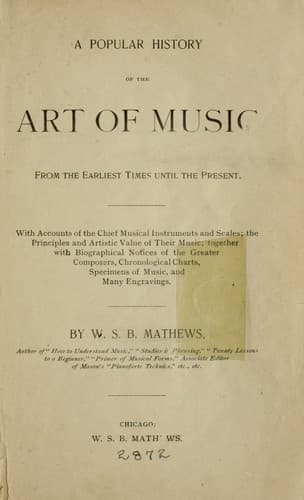
A Popular History of the Art of Music: From the Earliest Times Until the PresentMathews, W. S. B. (William Smythe Babcock)
History
A Popular History of the Art of Music: From the Earliest Times Until the Present
Mathews, W. S. B. (William Smythe Babcock)
Music -- History and criticism
He was direct in his speech, almost to rudeness, not, like Mozart,
attractive in his personal appearance, and rather awkward in society,
where he was continually breaking things, upsetting the water, the
ink, or whatever liquid was in his way. Nevertheless, there must have
been something attractive about this young man of independent manners,
for very early in life, and all the way through it, he made friends
with the aristocracy. Count Waldstein, a few years his senior, to whom
he afterward dedicated the so-called "Waldstein" sonata, Opus 53, in
C, early became interested in him, hired a piano for him and sent it
to his room, that he might have opportunity to practice. There was a
family of Von Breunings in Bonn, consisting of the mother, three boys
and a daughter, where the young Beethoven often stayed for several
days together. This was one of the most refined families in town, and
it was here that the unfortunate young Beethoven got his first
glimpses of a true home life, and his first realization of the
refining influence of woman's society. He learned English in order
that he might be able to read Shakespeare in the original. He also
learned a little Italian and French. In short, the boy appears at good
advantage from every point of view, except from that of mere
appearance. This life of labor and responsibility was broken in upon
when he was about seventeen (in 1787). He was sent to Vienna, and
there is a tradition that he played there before Mozart, who is
reported to have prophesied favorably concerning him. There is very
little left us concerning his first visit to the great Austrian
capital, then, as ever since, the home of music. He was soon back
again in Bonn, and there for yet another year and a half he went on
with his work. His mother dying, he had no longer any responsibility
to retain him there, so when he was about twenty-one he set out again
for Vienna, where all the remainder of his life was spent. At Vienna
he immediately began to give concerts, in which his piano playing was
the main feature, and his improvising upon themes presented by the
audience. This art always remained one of his great distinctions--the
surest proof of genius, the possession of musical fantasy, in which
every thought immediately suggests something else. He devoted himself
to serious study of counterpoint and composition under the instruction
of Haydn at first, but later with Albrechtsberger. His two great
elements of power at this period were his playing and his improvising.
Czerny says: "His improvisation was most brilliant and striking; in
whatever company he might chance to be, he knew how to produce such
an effect upon every hearer that frequently not an eye remained dry,
while many would break out into loud sobs; for there was something
wonderful about his expression, in addition to the beauty and
originality of his ideas, and his spirited manner of rendering them."
Public-domain text, read in full here on John Shaqi.
Reviews
Reviews
No reviews yet
Be the first to share your thoughts on this work.
Elsewhere in the archive
Join the Discussion
Join the discussion
Sign in to leave a comment or review.
Sign InorCreate an account