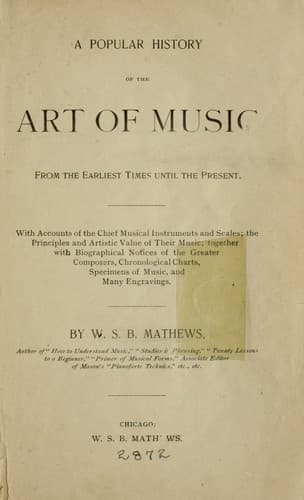
A Popular History of the Art of Music: From the Earliest Times Until the PresentMathews, W. S. B. (William Smythe Babcock)
History
A Popular History of the Art of Music: From the Earliest Times Until the Present
Mathews, W. S. B. (William Smythe Babcock)
Music -- History and criticism
The limits of the present work do not admit of following the career of
this great master in the detail which would otherwise be desirable. It
must suffice to mention the more salient features. Contrary to the
precedent established by Mozart, Beethoven was in no hurry to appear
as a composer of ambitious pieces. After the early practical
experiences above described, and the further advantage of studies in
Vienna under the best teachers at that time living, it was not until
1795 that he appeared as composer of his first concerto for pianoforte
and orchestra, a Mozart-like work, but with an _Adagio_ of true
Beethovenish flavor. A year later he published his first three sonatas
for pianoforte, dedicated to Haydn. These three works are in styles
totally unlike each other, and there is little or no doubt that each
one of them was modeled after some existing work, which at that time
was highly esteemed in Vienna. The first in F minor, is plainly after
one by Emanuel Bach in the same key. The _Adagio_ of this is
especially interesting, not only because it shows a freedom and a pure
lyric quality totally foreign to Emanuel Bach, and beyond Mozart even,
but because it was taken out of a quartette which he had written when
he was fifteen years old. This shows that even at that early age
Beethoven had arrived at the conception of his peculiar style of slow
movements, which differed from those of Mozart in having a more
song-like quality, and a deeper and more serious expression. The
impression of a deep soul is very marked in the _Largo_ of the first
concerto, and there are few of his later works which carry it more
plainly. In all, some sixty works precede this Opus 2, which is the
modest mark affixed to these three sonatas. The third, in C, is still
different from the other two, and was fashioned apparently after some
composition of Clementi or Dussek. The _Adagio_ takes a direction
which must have been regarded as not entirely successful, for nowhere
else does the composer follow it out. Then followed a succession of
pieces of every sort, not rapidly, like Mozart's compositions, as if
they represented the overflowing of an inexhaustible spring, but
deliberately, as if the world were not ready for them too rapidly, one
after another, each in succession carrying the treatment of the
pianoforte to a finer point, and each different from its predecessor,
whether of contemporaneous publication or of a former year, until by
the end of the century he had reached the "_Sonata Pathetique_," a
work which marked a prodigious advance in expression and boldness over
anything that can be shown from any other master of the period.
Mention having been made of the slow movements in these works, in
which point they were perhaps more strikingly differentiated from
those of the composers previous--the _Largo_ of the sonata in D major,
Opus 10, may be mentioned as an example of a peculiarly broad and
dramatic, almost _speaking_ rhapsody, or reverie, for piano, which not
Public-domain text, read in full here on John Shaqi.
Reviews
Reviews
No reviews yet
Be the first to share your thoughts on this work.
Elsewhere in the archive
Join the Discussion
Join the discussion
Sign in to leave a comment or review.
Sign InorCreate an account