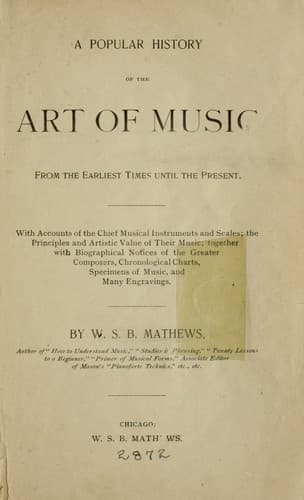
A Popular History of the Art of Music: From the Earliest Times Until the PresentMathews, W. S. B. (William Smythe Babcock)
History
A Popular History of the Art of Music: From the Earliest Times Until the Present
Mathews, W. S. B. (William Smythe Babcock)
Music -- History and criticism
The form thus established by Haydn, Mozart accepted, and followed in
all his symphonies, with few and unimportant variations. His additions
to the general ideal of orchestral effect were in the direction of a
sweeter _cantilena_, a vocal and song-like quality, which pervades
every movement, and which in the slow movement rises to a height of
refined and exquisite song never surpassed by any composer. Beethoven
is often more impassioned; at times more forcible. But it is never
possible to say of the pure spirit of Mozart, that this refined and
gentle soul might not have broken mountains and shaken the hills if he
had chosen to do so. His refinement is like that of a seraph, as we
see it illustrated in the feminine-looking faces of the Greek Apollos,
and the St. Michaels and archangels of Guido Reni and Raphael. It is
free from passion and toil; but no man dares set a limit to the
strength therein concealed. In the slow movements of the pianoforte
sonatas of Mozart we do not find this quality so plainly manifested.
The instrument was still too imperfect, and did not invite it.
Moreover, the greater portion of these compositions bear the
appearance of having been written for the use of amateurs. But in the
string quartette and the symphonies it is different. Here the spirit
of Mozart has free course, and he goes from one beauty to another,
with the sure instinct of a master before whom all tonal kingdoms are
wide open. This can be seen even in the pianoforte arrangements of the
greater symphonies. The melodies, apparently so simple and diatonic,
are susceptible of being sung with heartfelt fervor under the fingers
of the violinist, or by the voice of the great singer, and when so
sung they become transfigured with beauty--luminous from within, like
lovely angel faces, glowing with radiance from the higher realms of
bliss. Without this idea of singing, and more than this, of a pure
spirit singing, the Mozart adagios are open to the charge often made
against them in these later days by the unthinking, who find in them
only the external peculiarities of simplicity and diatonic quality,
with the unsensationalism which technical reserve implies.
[Illustration: Fig. 59.
REDUCED FACSIMILE OF THE TITLE PAGE OF BEETHOVEN'S SONATA, OPUS 26,
CONTAINING THE CELEBRATED FUNERAL MARCH.]
Public-domain text, read in full here on John Shaqi.
Reviews
Reviews
No reviews yet
Be the first to share your thoughts on this work.
Elsewhere in the archive
Join the Discussion
Join the discussion
Sign in to leave a comment or review.
Sign InorCreate an account