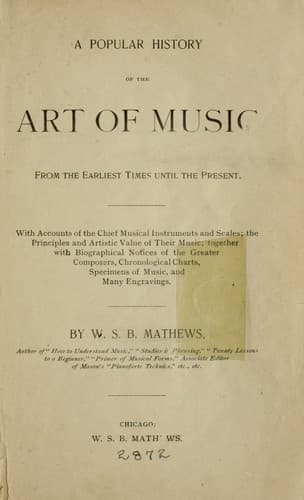
A Popular History of the Art of Music: From the Earliest Times Until the PresentMathews, W. S. B. (William Smythe Babcock)
History
A Popular History of the Art of Music: From the Earliest Times Until the Present
Mathews, W. S. B. (William Smythe Babcock)
Music -- History and criticism
Nor is it true that Beethoven is incapable of this elevated soaring in
the higher realms of the merely beautiful in song. There is generally
an undercurrent of deeper pathos in all his sustained slow movements,
but in the earlier symphonies, especially in the second, there is a
long slow movement of heavenly depth and quality. Indeed, without
pausing to individualize we may say once for all that the slow
movements of Beethoven are nearly as sweet and as forgetful, as
rapturous, as those of Mozart. Even when he takes the lower key of the
minor, with its implication of suffering and pain, there is still a
sweetness, which once heard can never be forgotten. Think of the
lovely _allegretto_ of the seventh symphony, with its persistent
motive of a quarter and two-eighths. Even in an arrangement for the
pianoforte this is still impressive; upon the organ yet more so; but
how much more so when given by the orchestra, with the lovely changing
colors of Beethoven's instrumentation! The progress from Haydn's slow
movement to that of Beethoven is in the direction of depth,
self-forgetfulness, and elevated reverie, having in it a quality
distinctly church-like, devotional, worshipful and reposeful in the
heavenly sense. The finest example of this is in the slow movement of
the ninth symphony of Beethoven, where the composer has one of those
lofty moods, which even in his younger times Mrs. Von Breuning used to
call his "_raptus_"--rapture of song.
In a technical point of view the handling of the themes becomes more
masterly in Beethoven than even in Mozart--mainly perhaps because the
symphonies of Beethoven represent a more mature point in his mental
and artistic career than do those of Mozart. The third symphony of
Beethoven was written in 1803, the composer being thirty-three years
old; the fourth waited until he was thirty-five or six. Mozart died at
the age of thirty-five, and whatever we have from his lofty pen came
to the young Mozart, not yet having reached middle life. Observe also
the rapidity with which these great works followed one another from
the pen of Beethoven, when once he had found his voice. The fifth
symphony was written in 1808. In the same year he wrote also the
sixth; four years later, in 1812, the next two symphonies, the seventh
and eight. Then a long pause, filled up with other works, and at
length when the composer was fifty-three years of age, in 1823, the
mighty ninth. If Mozart's life had been spared to enter into the more
comfortable and dignified openings which his death prevented, what
might we not have had from him!
Public-domain text, read in full here on John Shaqi.
Reviews
Reviews
No reviews yet
Be the first to share your thoughts on this work.
Elsewhere in the archive
Join the Discussion
Join the discussion
Sign in to leave a comment or review.
Sign InorCreate an account