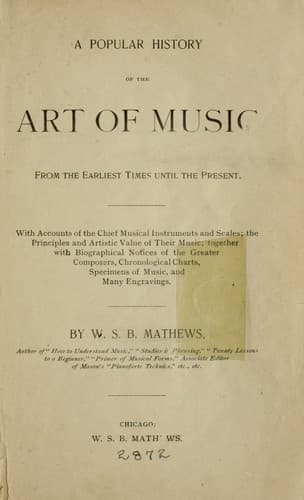
A Popular History of the Art of Music: From the Earliest Times Until the PresentMathews, W. S. B. (William Smythe Babcock)
History
A Popular History of the Art of Music: From the Earliest Times Until the Present
Mathews, W. S. B. (William Smythe Babcock)
Music -- History and criticism
Moreover, Beethoven occupied a different attitude toward the sonata
form from that which he held to the symphony. He deviated from the
sonata form in every direction, and this not alone in his later works,
when we might suppose he had become wearied with the repetition of his
ideas in the same order, but in his works of middle life, when as yet
he might apparently have gone on writing sonatas indefinitely, so
fresh, so novel and so varied were the tone pictures which he gave the
world under this name. He seems to have regarded music as an
improvisation, not to be held to some one fixed type of expression,
but free to go wherever the fancy of the poet took him, to the end
that the entire heavens of the tone world might in time be visited. He
expects of his readers an element of the devotee. It is not for
amateurs that he writes, still less for the votaries of fashionable
society, with its emptiness and repeated insincerities. There is a
suggestion of entering into the closet, and of shutting the door, as a
prerequisite to the full enjoyment of these ineffable pictures and
images which come from his revelation.
In the present full-grown faith in the doctrine of the capacity of man
for a development continually progressive, it would be presumptuous to
say that the three composers, Haydn, Mozart and Beethoven, have
reached the limit of art, so far as instrumental music goes. In the
nature of the case, there is not, nor can there be an _Ultima Thule_
in art. Whatever the splendor of color, the nobility of conception, or
the sincerity and loyalty of purpose, and however resplendent the
works created by these exceptional talents, there is reason to hope
that better works still may yet be in store. Stronger and yet stronger
imaginations, more perfect technique of expression and finer
inspiration, may yet be the lot of fortunate individuals of the
twentieth century, inheriting the richly diversified musical
experiences of the present time. But in one direction there is little
doubt that these three great masters _did_ carry the art of
instrumental music to a pinnacle beyond which no one as yet has been
able to soar. They represent the climax of classical art. In the
nature of the case, the term classical itself is subject to an element
of uncertainty. According to the philosopher Hegel, the classical is
that art in which the _form_ is beautiful and wholly satisfactory in
symmetry, while the _content_ exactly matches it in fullness and
beauty. Or, in ordinary usage, the classical is the first-class, the
superior, the highly finished, the standard. And since music is a
matter of sense perception, and the impressions resulting from it are
in some degree dependent upon the ability of the hearer to find the
principles of unity (in other words, "the sense of it"), every
generation extends the list of the classical, and includes much which
the preceding one found imperfect and strained. So far as our
Public-domain text, read in full here on John Shaqi.
Reviews
Reviews
No reviews yet
Be the first to share your thoughts on this work.
Elsewhere in the archive
Join the Discussion
Join the discussion
Sign in to leave a comment or review.
Sign InorCreate an account