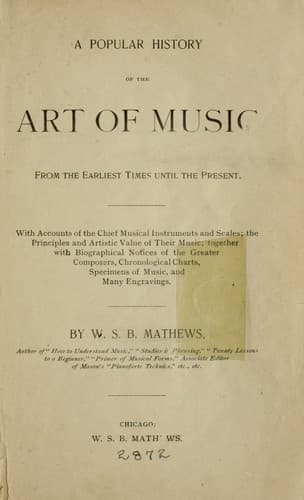
A Popular History of the Art of Music: From the Earliest Times Until the PresentMathews, W. S. B. (William Smythe Babcock)
History
A Popular History of the Art of Music: From the Earliest Times Until the Present
Mathews, W. S. B. (William Smythe Babcock)
Music -- History and criticism
Thus by the combined efforts of all these composers, of
Schubert no less than of the three great masters of whom we are more
particularly speaking, the symphony came to its full expression.
In their relation to the sonata, these three great masters do not
stand in the same position of _quasi_-equality. Haydn is here the
first, as already in the symphony. But in his sonatas he is always
rather hampered, and never attains the flow of his slow melodies for
the violin. Mozart, also, while a beautiful player upon the pianoforte
of his day, did not possess the prescience of Beethoven, who was able
to see over the pianoforte of his time and write as if he felt the
assurance of the nobler and yet nobler instruments of these later
times. Here he stands with Bach, who in his great Chromatic Fantasia
and Fugue requires and confidently expects the breadth of tone and the
power of the modern piano. It was Beethoven's fortune to live during
the early days of the modern instrument. Just after his death the era
of virtuoso piano playing began, the first appearances of Thalberg
having been made as early as about 1830. He was himself a great
pianist, as we see in the concertos which he wrote, always intending
to play them at some concert or other in near prospect. Occasionally
indeed he overshot his mark, as notably in the fifth, which, being
finished just before his concert in 1809, he found too difficult for
his fingers, whereupon he was obliged to fall back on the third.
Moreover, the pianists Hummel and Dussek were already before the
public, and Clementi had made his concert tours, and established the
lines of the classical technique upon its brilliant side. All these
influences find their illustration in the music of Beethoven, and
especially find illustration in the last and greatest of his
pianoforte sonatas. These beautiful tone poems were long regarded as
impossible. But the genius of Schumann and Liszt came to their rescue
by introducing a new style of touch and technique, which, when once
found, proved to be the link missing for the proper interpretation of
these till then obscure works.
Public-domain text, read in full here on John Shaqi.
Reviews
Reviews
No reviews yet
Be the first to share your thoughts on this work.
Elsewhere in the archive
Join the Discussion
Join the discussion
Sign in to leave a comment or review.
Sign InorCreate an account