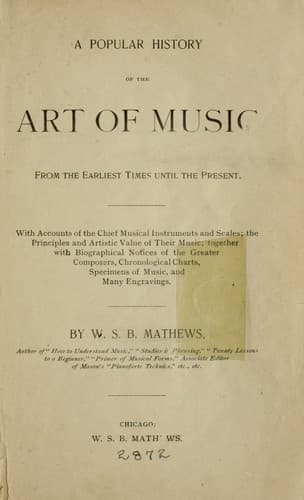
A Popular History of the Art of Music: From the Earliest Times Until the PresentMathews, W. S. B. (William Smythe Babcock)
History
A Popular History of the Art of Music: From the Earliest Times Until the Present
Mathews, W. S. B. (William Smythe Babcock)
Music -- History and criticism
also a love affair. Gluck was deeply in love with the beautiful and
charming daughter of a rich merchant, who upon no account would
consent to her marriage with a musician. So Gluck went back to Italy,
and there he wrote another opera, rather better in quality than his
previous ones. Early in 1750 the inexorable parent died, and late in
the year Gluck married the woman of his choice, who made him a model
wife, being educated above the average of her times, and entering into
his ideals and aspirations with ever ready sympathy. Her wealth also
placed the composer in an easy position as regarded the world, and
permitted him to devote himself to study. For nearly ten years
following Gluck produced occasionally an opera, but as yet the _man_
had not arrived; all these were early and apprentice works. At length
in 1762 was produced his first master work, "Orpheus and Eurydice,"
the libretto having been written by the imperial councillor Calzabigi.
The novelty of this great work was not above the appreciation of the
Viennese public of the day. "Orpheus" made a decided success. Its
principal innovations consisted in its more powerful instrumentation,
the introduction of a chorus having an integral part in the movement
of the piece, and in the highly dramatic treatment of the second act,
where Orpheus descends into the lower world to seek his lost love.
Nevertheless, the composer had not reached true self-consciousness. A
retrogression followed. He went back to Metastasio, and in conjunction
with him produced three or four small operas, all in his earlier
style. But in 1767 he returned to Calzabigi, and upon a libretto of
his wrote "_Alceste_" which was produced at the Vienna opera house in
1767 with vastly more success than "Orpheus." The story is that of the
tragedy of Euripides, and the music is exclusively severe and tragic.
The public was divided concerning the merit of the new work. Already
the notion of a music of the future had been conceived, and the notion
suggested that only in a more self-forgetful future would a work of
such severity and of such lofty aim find acceptance.
Public-domain text, read in full here on John Shaqi.
Reviews
Reviews
No reviews yet
Be the first to share your thoughts on this work.
Elsewhere in the archive
Join the Discussion
Join the discussion
Sign in to leave a comment or review.
Sign InorCreate an account