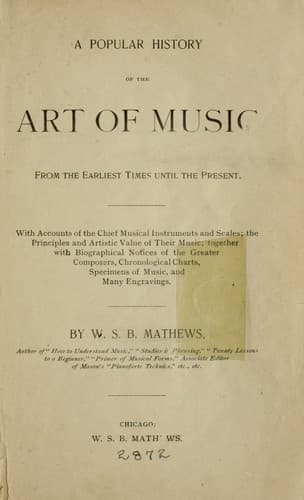
A Popular History of the Art of Music: From the Earliest Times Until the PresentMathews, W. S. B. (William Smythe Babcock)
History
A Popular History of the Art of Music: From the Earliest Times Until the Present
Mathews, W. S. B. (William Smythe Babcock)
Music -- History and criticism
In the dedicatory epistle to the duke of Tuscany, prefixed to the
score, Gluck defines his intentions. He says: "I seek to put music to
its true purpose; that is, to support the poem, and thus to strengthen
the expression of the feelings and the interest of the situation,
without interrupting the action. I have therefore refrained from
interrupting the actor in the fervor of his dialogue by introducing
the accustomed tedious _ritournelle_; nor have I broken his phrase at
an opportune vowel that the flexibility of his voice might be
exhibited in a lengthy flourish; nor have I written phrases for the
orchestra to afford the singer opportunity to take a long breath
preparatory to the accepted flourish; nor have I dared to hurry over
the second part of an aria, when such contained the passion and the
most important matter, to find myself in accord with the conventional
repeat of the same phrase four times. As little have I permitted
myself to close an aria where the sense was incomplete, solely to
afford the singer an opportunity of introducing a cadenza. In short, I
have striven to abolish all these bad habits, against which sound
reasoning and true taste have been struggling now for so long in
vain."
There were several numbers in "_Alceste_" which exercised an influence
upon subsequent composers, among the more notable being the speech of
the oracle, which Mozart must have had in mind in writing the
commandatore's reply to Don Giovanni; and the sacrificial march,
which probably influenced the priests' march in the "Magic Flute."
Gluck was forty-eight when he wrote "Orpheus," and fifty-three when
"_Alceste_" appeared.
Public-domain text, read in full here on John Shaqi.
Reviews
Reviews
No reviews yet
Be the first to share your thoughts on this work.
Elsewhere in the archive
Join the Discussion
Join the discussion
Sign in to leave a comment or review.
Sign InorCreate an account