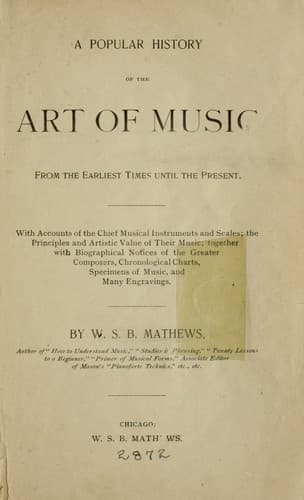
A Popular History of the Art of Music: From the Earliest Times Until the PresentMathews, W. S. B. (William Smythe Babcock)
History
A Popular History of the Art of Music: From the Earliest Times Until the Present
Mathews, W. S. B. (William Smythe Babcock)
Music -- History and criticism
Of the French stage during this epoch it is to be observed that
nothing of a large and serious character was produced upon it, except
the operas of Gluck, which of course were not indigenous to France.
What progress was made by the composers before mentioned, and others
of less importance, consisted in acquiring fluency, ease and effective
construction. The ground had been prepared from which the century
following would reap a harvest.
III.
In Italy during the eighteenth century, opera continued to be
cultivated by a succession of gifted and prolific composers. At the
beginning of the century, the great Alexander Scarlatti was at the
height of his career, as also were Lotti and the younger masters
mentioned in the former chapter. All these composers followed in the
style established by Scarlatti and Porpora. The most talented of the
Italians of this period was Giovanni Batista Pergolesi (1710-1737).
This gifted genius was born at Jesin, in the Roman states, but when a
mere child, was admitted to the conservatory "Of the Poor in Jesus
Christ" at Naples, where his education was completed. He commenced as
a violin player, and attracted attention while a mere child by his
original passages, chromatics, new harmonies and modulations. A report
of his performances of this kind being made to his teacher Matteis, he
desired to hear them for himself, which he did with much surprise, and
asked the boy whether he could write them down. The next day the
youngster presented himself with a sonata for the violin, as a
specimen of his power; this led to his receiving regular instruction
in counterpoint. The first composition of his was a sacred drama
called "_La Conversione di St. Guglielmo_," written while he was still
a student. It was performed with comic intermezzi (_sic!_) in the
summer of 1731, at the cloister of St. Agnello. The dramatic element
in this work is very pronounced, and the violin is treated with
considerable feeling. His first opera, "_La Salustia_," was produced
in 1731. It is notable for improvement in the orchestration. In the
winter of this same year he wrote his comic intermezzo, "_La Serva
Padrona_," a sprightly operetta, which had a moderate success at the
time, but afterward for nearly a hundred years was played in all parts
of Europe. He wrote several other operas, which had but moderate
success, although many of them were performed with considerable
applause after his death. By general consent the most beautiful work
of Pergolesi was his "_Stabat Mater_," which was written to order for
a religious confraternity, for use on Good Friday, in place of a
"_Stabat_" by Scarlatti, the price paid being ten ducats--about nine
dollars. It is for two voices, a soprano and contralto, and is
excellently written. No sooner was he dead than his music immediately
became the object of admiration, his operas and lighter pieces being
played in all parts of Italy. He died at the age of twenty-six, being
Public-domain text, read in full here on John Shaqi.
Reviews
Reviews
No reviews yet
Be the first to share your thoughts on this work.
Elsewhere in the archive
Join the Discussion
Join the discussion
Sign in to leave a comment or review.
Sign InorCreate an account