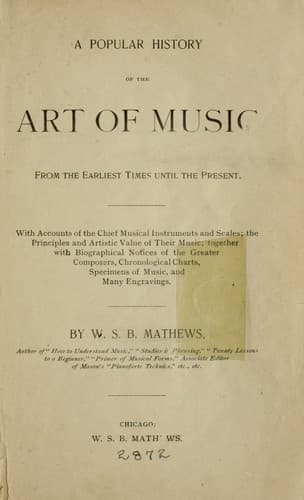
A Popular History of the Art of Music: From the Earliest Times Until the PresentMathews, W. S. B. (William Smythe Babcock)
History
A Popular History of the Art of Music: From the Earliest Times Until the Present
Mathews, W. S. B. (William Smythe Babcock)
Music -- History and criticism
the youngest master who has ever left a permanent impression in
musical history.
One of the most prolific composers of this period was Nicolo Jomelli
(1714-1774). Jomelli represents the Neapolitan school, having been
educated first at the conservatory of San Onofrio, and later at that
of "_La Pieta de' Turchini_." His earlier inclination was church
music, and in order to perfect himself in it he went to Rome. This was
in 1740, and two of his operas were there produced. He afterward
visited Vienna, where he produced several operas, and in 1749 he was
appointed assistant musical director at St. Peter's in Rome, a
position which he held for five years, after which he went to
Stuttgart, as musical director. While in Germany he had a very great
reputation as an opera composer. In 1770 Mozart wrote from Naples,
"The opera here is by Jomelli; it is beautiful, but the style is too
elevated as well as too antique for the theater." His later life was
spent in Naples. Besides many operas he wrote a number of
compositions for the church. It perhaps gives a good idea of the
estimation in which he was held while living, that a critic highly
esteemed in his day said that it would be a sorry day for the world
when the operas of Jomelli were forgotten, at the same time
pronouncing them superior to those of Mozart. Not a single line of
Jomelli is performed at the present time, nor is likely ever to be;
but the works of Mozart still retain their popularity.
Another prolific composer of the Neapolitan school was Antonio Maria
Gasparo Sacchini (1724-1786). This clever composer was very successful
in his lifetime, his operas being produced in all parts of Europe.
Nevertheless they are monotonous in character, and have little depth.
He has very little importance for the history of music. Still another,
also from the Neapolitan school, was Piccini (1728-1800). His first
operas were produced in 1754, and from that time on for about forty
years he was a very popular composer, his works being produced in
every theater, and in 1778 he was set up as an idol by his admirers,
in opposition to Gluck. He was highly honored by Napoleon, who took
pleasure in distinguishing him for the sake of humbling several much
more deserving musicians. The complete list of his works in Fetis
contains eighty operas. His biographer credits him with one hundred
and thirty-three. Yet another composer of the Neapolitan school was
Giovanni Paisiello (1741-1815). From the time of his first operas to
his death, he was highly esteemed as a composer. In 1776 he was
invited by the Empress Catharine to St. Petersburg, where he lived for
eight years, and among other operas which he composed while there was
"_Il Barbiere di Siviglia_." In 1799 he was called to Paris, where
Napoleon very greatly distinguished him. Upon leaving Paris, in 1803,
Napoleon desired him to name his successor, when he performed the
creditable act of nominating Lesueur, who was at that time unknown.
Public-domain text, read in full here on John Shaqi.
Reviews
Reviews
No reviews yet
Be the first to share your thoughts on this work.
Elsewhere in the archive
Join the Discussion
Join the discussion
Sign in to leave a comment or review.
Sign InorCreate an account