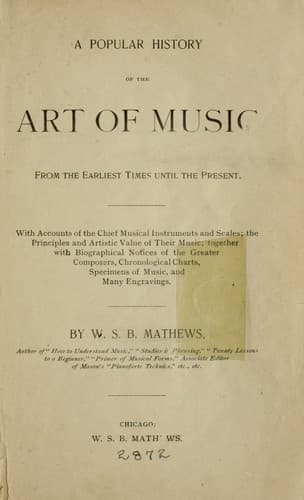
A Popular History of the Art of Music: From the Earliest Times Until the PresentMathews, W. S. B. (William Smythe Babcock)
History
A Popular History of the Art of Music: From the Earliest Times Until the Present
Mathews, W. S. B. (William Smythe Babcock)
Music -- History and criticism
The list of his works embraces ninety-four operas and 103 masses. His
music was melodious and pleasing, but rather feeble; he is regarded,
however, as the inventor of the concerted finale, which has since been
so largely developed in opera. Perhaps the best of all the Neapolitan
composers of this half century was Zingarelli (1752-1827). Zingarelli
was not only a good musician and a good composer, but a man of ability
and principle. He was an associate pupil with Cimarosa. After leaving
the conservatory he took lessons upon the violin, and in 1779 produced
a cantata at the San Carlo theater. Two years later his first opera
was produced at the same theater with great applause, "_Montezuma_."
He then went to Milan, where most of his later works were produced. He
was an extremely rapid worker, his librettist stating it as a fact
that all the music of his successful opera of "_Alsinda_" was composed
in seven days, although the composer was in ill health at the time.
Another of his best works, his "_Giulietta e Romeo_," was composed in
about eight days. It is said that this astonishing facility was
acquired through the discipline of his teacher Speranza, who obliged
his pupils to write the same composition many times over, with change
of time and signature, but without any change in the fundamental
ideas. While busily engaged as a popular opera composer, Zingarelli
found time to compose much church music, his most important works
being masses and cantatas. Of the former there still exist a very
large number; of the latter about twenty. He made a trip to France in
1789, where he brought out a new opera, "_L'Antigone_"; he was
appointed musical director at the cathedral at Milan in 1792, and two
years later at Loretto, Naples. Thence he was transferred to the
Sistine chapel at Rome, and finally in 1813 he was appointed director
of the Royal College of Music at Naples, in which position he spent
the remainder of his long and active life.
He produced about thirty-two operas, twenty-one oratorios and
cantatas, and there are about 500 manuscripts of his in the "_Annuale
di Loreto_." As a composer of comic operas Zingarelli became popular
all over Europe, but he was nevertheless a serious, even a devout
composer. He was extremely abstemious, rose early, worked hard all
day, and, after a piece of bread and a glass of wine for supper,
retired early to rest. He was never married, but found his
satisfaction in the successes of his musical children, among whom were
Bellini, Mercadante, Ricci, Sir Michael Costa, Florimo, etc.
IV.
Public-domain text, read in full here on John Shaqi.
Reviews
Reviews
No reviews yet
Be the first to share your thoughts on this work.
Elsewhere in the archive
Join the Discussion
Join the discussion
Sign in to leave a comment or review.
Sign InorCreate an account